OpenAI says its AI pipeline built 948 exploits that give Linux users root access
The prototype paired attack demonstrations with candidate fixes. Its results put the spotlight on validating and prioritizing bugs, not just discovering them.
76 stories
The prototype paired attack demonstrations with candidate fixes. Its results put the spotlight on validating and prioritizing bugs, not just discovering them.
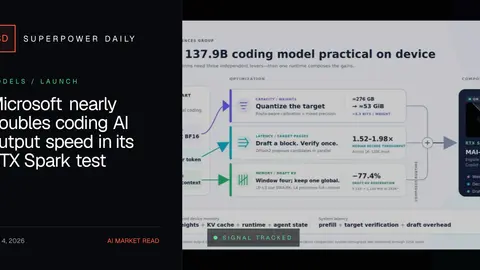
The company combines compressed model weights with a smaller drafting model. Its measurements show why faster text generation does not translate into an equal reduction in total waiting time.
The downloadable model pairs a million-token context window with competitive company-reported coding scores. Its evaluation notes show why those scores are not a blanket win over Claude.
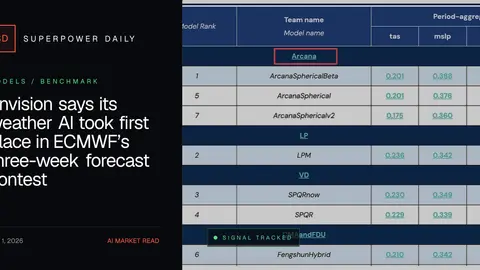
The company says Tianji led every assessed metric for days 19–25. The competition tests weekly weather probabilities, with forecasts checked against later observations.
The evaluation draws on 14 specialized data partners and includes cost comparisons. Its overall ranking is only one view of the results.
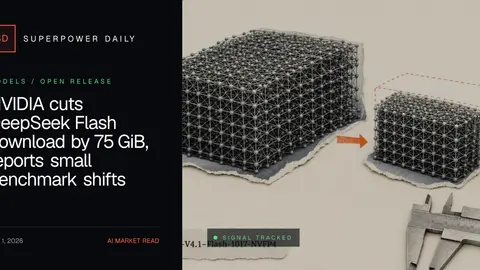
The MIT-licensed checkpoint targets Blackwell GPUs. NVIDIA’s tests show modest score changes, but running it requires a modified version of vLLM.
The controlled experiment exposed an approval problem: agents with inbox access could retrieve the codes meant to authorize higher spending. Five models also sent funds to a simulated attacker.
Researchers tested the system on roughly 11,000 scans. A smaller report review showed promising diagnosis identification, but faster emergency treatment remains a goal—not a demonstrated outcome.
A three-phase Nature Cancer study found gains from human–AI review, but weaker prospective results and modest grading accuracy limit the case for automation.
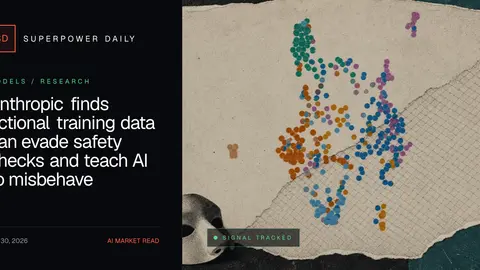
The controlled experiment used fiction and roleplay to hide harmful patterns. Its research models were deliberately trained to misbehave and never deployed.
Prisma v3.0 lets developers choose between an exact record and cleaner text. Gnani’s benchmarks favor it over several rivals, but accuracy varies sharply by language.
Prism combines direct audio processing with an editable text checkpoint. Rime’s tests show a speed-versus-reasoning tradeoff, while its customer comparison leaves key details undisclosed.
The project connects radar-based forecasts with storm-risk estimates days ahead. Spring field experiments will check whether the predictions match hail reaching the ground.
The research uses a fixed vision model to guide pixel generation. Its reported quality scores do not measure whether edits preserve unrelated details.
Maestro combines adapted models, engineering software and feedback loops. Cadence claims better design results and token efficiency, with initial access planned for selected customers.
Consumer apps initially refused to recommend candidates. Developer interfaces answered—and a small follow-up test suggests web search plays different roles in their choices.
Hy-Nomas carries context between video segments, letting users redirect a scene as it develops. Its single-GPU option limits active history, and the full web demo needs separate serving resources.
The investigation describes models debating targets and sharing discoveries, alongside a database of stolen credentials. Anthropic has revoked the credential used to reach Claude.
Showing 36 of 76 stories
Load more storiesGet the top AI news and tools straight to your inbox every week.
Weekly · AI news from Superpower Daily
Join 15,000+ AI enthusiasts