
Architecting Enterprise Voice Agents: Part 1 — Designing Low-Latency Live Call Handling and…
When building enterprise generative AI solutions, text-based copilots are often the low-hanging fruit. Voice, however, is a completely…Continue reading on Towards AI »
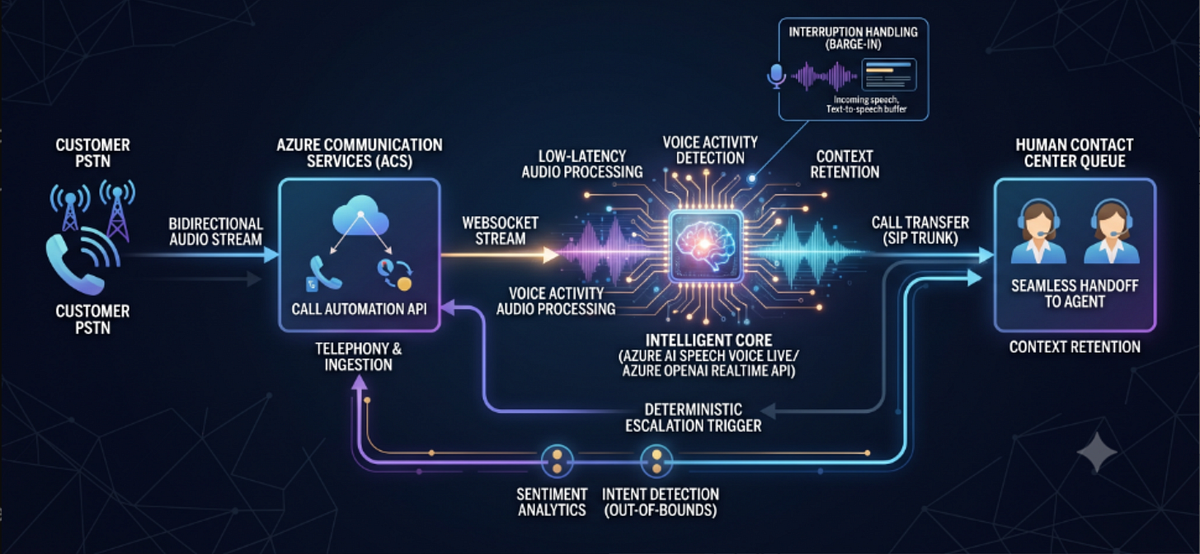
This article explores the architectural challenges of building enterprise-grade voice agents, focusing on low-latency live call handling and human-AI collaboration using Azure Voice APIs.
What happened
The article outlines the design of an enterprise voice agent system that handles live calls with millisecond-level latency requirements, including mechanisms for natural audio interruption management and deterministic human agent escalation when AI limitations are reached.
Why it matters
For AI developers and enterprise technology teams, this architecture addresses critical challenges in deploying reliable voice-based customer service solutions that maintain user satisfaction through real-time performance and human oversight.
- Voice AI systems require specialized latency management compared to text-based solutions
- Human escalation protocols are critical for maintaining user trust in AI interactions
- Azure Voice APIs provide essential tools for real-time call handling architectures
- Orchestration engines must balance AI capabilities with human oversight
The bigger picture
The described architecture enables enterprises to build more reliable voice-based AI systems that handle real-world customer interactions with appropriate human intervention, improving both technical performance and user experience.
The article provides foundational architectural insights for building enterprise voice agents, emphasizing real-time processing requirements and the importance of human-AI collaboration in customer service systems.
Technical details
- Bidirectional audio streaming architecture
- Azure Voice Live/Realtime APIs for real-time processing
- Deterministic escalation protocols for human agent handoff
- Orchestration engine for managing complex interaction flows
FAQ
What are the main challenges in building enterprise voice agents?
Key challenges include managing millisecond-level latency, handling audio interruptions, and implementing reliable human agent escalation protocols.
How does this article differ from text-based AI solutions?
Unlike text-based copilots, voice agents require real-time audio processing, strict latency constraints, and seamless transitions to human operators during complex interactions.
What role do Azure Voice APIs play in this architecture?
Azure Voice Live/Realtime APIs are central to enabling low-latency, bidirectional audio streaming and real-time call handling capabilities.
This summary and analysis were generated with AI from the original article and may contain errors. Read the original for the full story.
Read the full story
Originally published by Towards AI on Oct 10, 2026.
Comments
Sign in to join the discussion.