
Can we use a System One model in the browser?
I ran Laya, an open 421M-parameter decision model, in a browser tab and measured what it costs: download, speed and accuracy. In mid-September, TypeSafe AI released Jev, a “System One” model. It doesn’t write text.
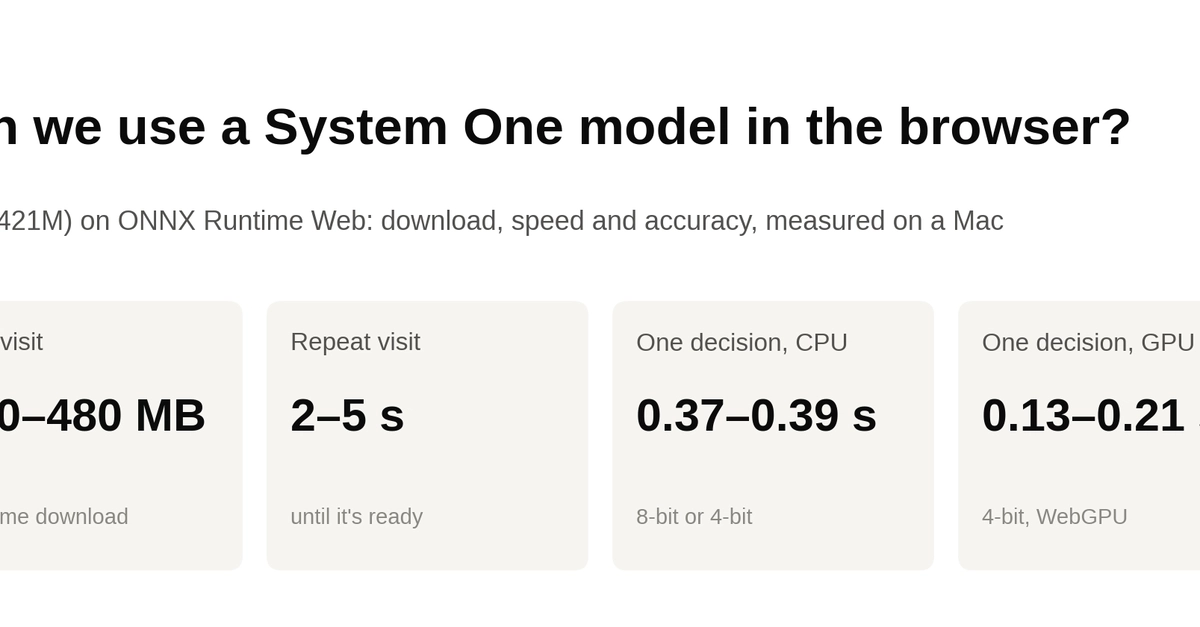
This article explores the feasibility of running a System One model, specifically Laya, directly in a browser without relying on a server or API key. It details the performance, download time, and accuracy of the model when executed in a browser environment.
What happened
The article describes the testing of Laya, an open-source decision model, in a browser environment. It evaluates the model's performance in terms of download time, speed, and accuracy. The model was tested using different quantization levels (8-bit and 4-bit) and hardware configurations (CPU and GPU). The results show that while the model can run in the browser, there are trade-offs in speed, memory, and accuracy depending on the setup.
Why it matters
For AI developers and web app creators, this article provides insights into deploying models directly in the browser, which can reduce dependency on servers and improve privacy. However, it also highlights limitations such as memory usage and performance degradation in background tabs, which are important considerations for real-world applications.
- Running models in the browser is feasible for quick, user-triggered decisions but has limitations in background execution.
- Quantization (4-bit vs. 8-bit) affects speed and accuracy, with GPU support being crucial for performance.
- Memory usage is significant, and background tabs in Chrome can severely impact performance.
- Fine-tuning the model improves accuracy, and the model should not be trusted without further validation.
- Browser compatibility and hardware limitations must be considered when deploying models in the browser.
The bigger picture
The ability to run models in the browser can enhance privacy and reduce latency for certain applications, such as ticket routing or lead scoring. However, the limitations in background execution and accuracy with 4-bit quantization suggest that server-side processing may still be necessary for critical tasks.
The article concludes that while it is possible to run a System One model like Laya in the browser, the practicality depends on the use case. It is suitable for applications that require quick, user-initiated decisions but not for background tasks or high-accuracy guardrail systems.
Technical details
- Laya is a 421M-parameter model with a decision head, built on ModernBERT-large.
- The model was ported to ONNX Runtime Web with 8-bit and 4-bit quantization.
- The 8-bit build uses int8 block-128 MatMulNBits weights, while the 4-bit uses int4 block-32 weights.
- The model runs on Apple Silicon Mac with Chromium-based browsers, and performance is measured using session.run() and memory usage.
FAQ
Can Laya run in the browser without a server?
Yes, Laya can run in the browser using ONNX Runtime Web, but performance depends on quantization and hardware.
Which quantization level is better for the GPU?
The 4-bit quantization is better for GPU performance, but the 8-bit version is more compatible with WebGPU.
Does the model lose accuracy with 4-bit quantization?
Yes, the 4-bit version shows a higher probability shift for guardrail questions, suggesting a need for server-side checks.
What are the memory requirements for running Laya in the browser?
The 8-bit model uses around 1.54 GB of memory, and the 4-bit version was not measured.
Is the model suitable for background tasks in Chrome?
No, Chrome prioritizes foreground tabs, making background execution slow and impractical.
This summary and analysis were generated with AI from the original article and may contain errors. Read the original for the full story.
Read the full story
Originally published by Dev.to AI on Sep 30, 2026.
Comments
Sign in to join the discussion.