
How I calibrated an LLM judge to grade like me, 25 cheaper
Businesses that sell technical products answer the same kind of question every day. "What's the accuracy on this range?" "Can it measure through a coating, and how thick?" "Does it come with a calibration certificate?" The answers sit in product datasheets and manuals.
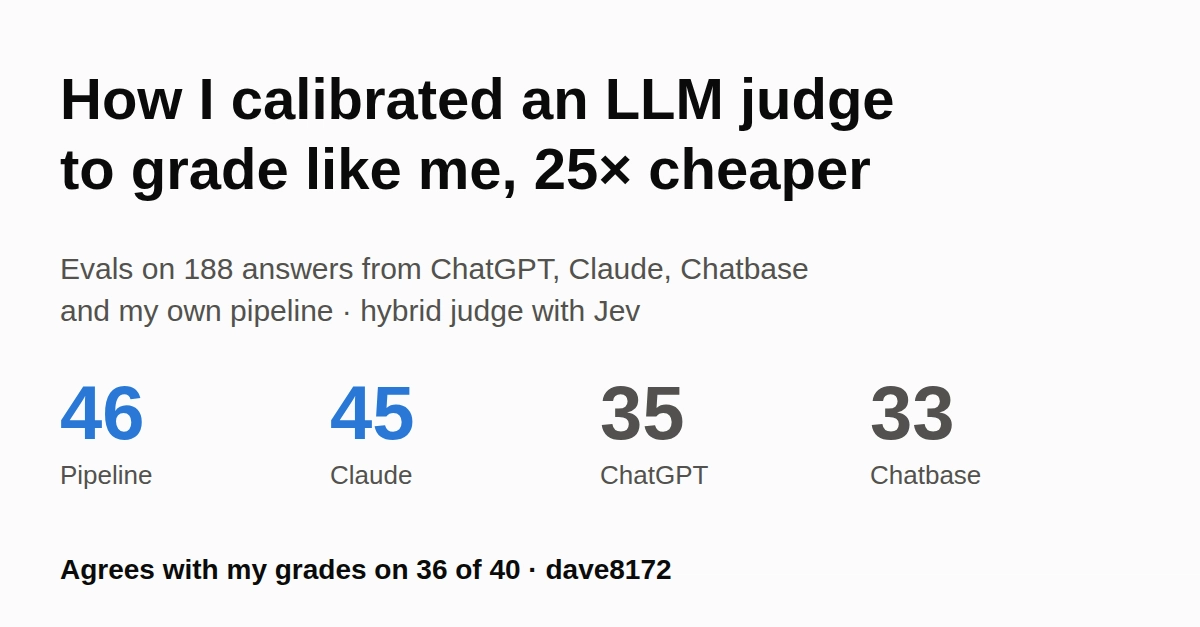
This article discusses the author's experience in calibrating an AI judge to evaluate the accuracy of AI-generated answers to technical product questions, highlighting the challenges and insights gained from the process.
What happened
The author conducted an experiment to evaluate the accuracy of AI systems in answering technical product questions. They tested multiple AI models, including Claude, ChatGPT, and Chatbase, using the same dataset of product datasheets and customer questions. A custom judge was developed to grade the responses, ensuring alignment with the author's standards. The process involved checking for accuracy, consistency, and adherence to specific rules, with the final system achieving high accuracy and efficiency.
Why it matters
This experiment is significant for AI developers and businesses that rely on accurate AI-generated responses to technical questions. It demonstrates how to build and calibrate an AI judge to ensure reliability and consistency, which is crucial for maintaining trust and quality in AI-driven customer support and product documentation.
- Calibrating an AI judge is essential for ensuring accurate and reliable AI-generated responses.
- A hybrid system combining code and AI models can achieve high accuracy and efficiency.
- Cohen's kappa is a useful metric for evaluating the agreement between AI judges and human standards.
- Adhering to specific rules and guidelines improves the quality of AI-generated answers.
- Testing and refining the judge's performance is crucial for maintaining accuracy and consistency.
The bigger picture
The calibrated AI judge provides a reliable and efficient way to evaluate AI-generated answers, ensuring they meet the required standards for technical accuracy and customer satisfaction. This has practical implications for businesses that rely on AI to answer customer questions and maintain product documentation.
The author's experiment demonstrates the importance of calibrating an AI judge to ensure accurate and reliable responses to technical product questions. The final system achieved high accuracy and efficiency, providing a valuable solution for businesses that rely on AI for customer support and product documentation.
Technical details
- The author used a pipeline combining Claude Sonnet with page citations for accurate answers.
- A hybrid system was developed using code for numerical checks and a model for semantic understanding.
- Cohen's kappa was used to measure the agreement between the AI judge and the author's grading standards.
- The system was tested on 188 answers, with a focus on accuracy, completeness, and adherence to rules.
- The final system achieved high accuracy with minimal cost and fast processing.
FAQ
What was the main goal of the experiment?
The main goal was to evaluate the accuracy of AI systems in answering technical product questions and to develop a calibrated AI judge that aligns with the author's standards.
Which AI systems were tested?
The author tested Claude, ChatGPT, and Chatbase, along with a custom pipeline combining Claude Sonnet with page citations.
How was the AI judge calibrated?
The judge was calibrated by grading 20 answers blind, comparing the results with the author's standards, and refining the grading rules based on the discrepancies.
What was the accuracy of the final system?
The final system achieved high accuracy, with a hybrid approach combining code for numerical checks and a model for semantic understanding.
What was the cost of the experiment?
The experiment cost about $8 in API calls, with most of the cost attributed to initial mistakes that were later corrected.
This summary and analysis were generated with AI from the original article and may contain errors. Read the original for the full story.
Read the full story
Originally published by Dev.to AI on Oct 3, 2026.
Comments
Sign in to join the discussion.