
Liquid AI d1 API Review: Pricing, Vision, and Limits
Liquid AI d1 API review covering $0.04/M pricing, vision inputs, zero output tokens, API usage, benchmarks, and production limits.
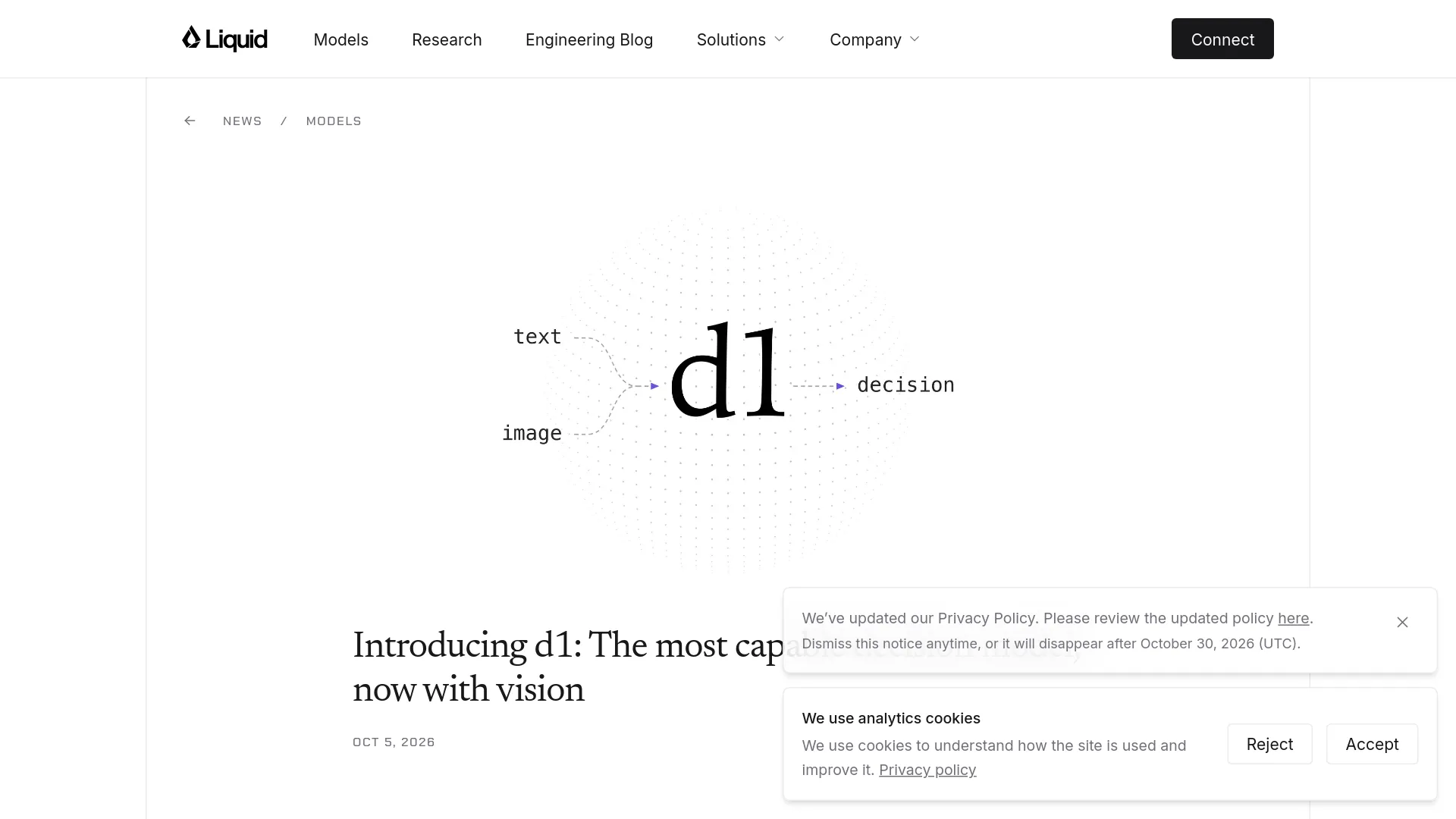
This article reviews the Liquid AI d1 API, focusing on its pricing, vision capabilities, and limitations. It provides an in-depth analysis of the model's features, cost structure, and use cases.
What happened
The article discusses the release of Liquid AI d1, a multimodal decision model that accepts text and images. It outlines the pricing structure, technical details, and use cases for the API, along with comparisons to other models and recommendations for its application.
Why it matters
For AI developers and businesses, understanding the capabilities and limitations of decision models like d1 is crucial for optimizing costs and ensuring accurate automated decisions. The article provides insights into when d1 is suitable and when alternative solutions might be better.
- d1 is suitable for tasks requiring structured decisions but not for generating prose or code.
- Pricing is cost-effective for high-volume input tasks but may vary with gateway fees.
- Testing with labeled data is essential to validate performance before deployment.
- d1's vision capabilities are available but require local testing for accuracy.
- The model's performance claims should be independently verified for critical applications.
The bigger picture
The article suggests that d1 can be a cost-effective solution for specific decision-making tasks, but its effectiveness depends on the application's requirements and the availability of labeled data for testing. Businesses should evaluate d1 against their specific needs before adoption.
The Liquid AI d1 API offers a cost-effective solution for specific decision-making tasks, with multimodal support and a clear pricing model. However, its effectiveness depends on the application's requirements and thorough testing with labeled data.
Technical details
- d1 accepts text, images, or both as inputs.
- The API uses three question types: Noul (yes/no), Choice (label selection), and Score (ordered scale evaluation).
- Pricing is $0.04 per million input tokens with no output token charges.
- The model's latency is reported to be 200-300 ms for text decisions.
- Image processing involves 1.5 tokens per 32x32 pixel patch.
FAQ
Is Liquid AI d1 free to use?
No, d1 charges $0.04 per million input tokens with no output token charges. Gateway or third-party platform fees may apply.
Can d1 run locally?
As of the October 5 release, Liquid AI has not announced downloadable weights for d1. Open weights for future models are planned, but d1 itself is not available for local deployment.
What context window does d1 have?
The October 5 announcement does not specify a context maximum. Production designs should verify the active limit through the chosen provider.
Is d1 better than a normal classifier?
There is not enough independent evidence for a universal answer. d1 is attractive when labels or rubrics change frequently, while a stable, inexpensive classifier may be better for narrow tasks with abundant labeled data.
When should I use d1 over a general LLM?
Use d1 when the output is fixed, uncertainty is useful, and policies change often. For applications needing explanations, prose, code, or reasoning, a general LLM is more suitable.
This summary and analysis were generated with AI from the original article and may contain errors. Read the original for the full story.
Read the full story
Originally published by Nano Imagine Blog on Oct 5, 2026.
Comments
Sign in to join the discussion.