
OAuth 2.0 Token Exchange — Laying the Foundation for AI Agent Authorization
OAuth 2.0 Token Exchange — Laying the Foundation for AI Agent Authorization Background In a previous article, I walked through the three most common OAuth 2.0 grant flows: Authorization Code Flow …
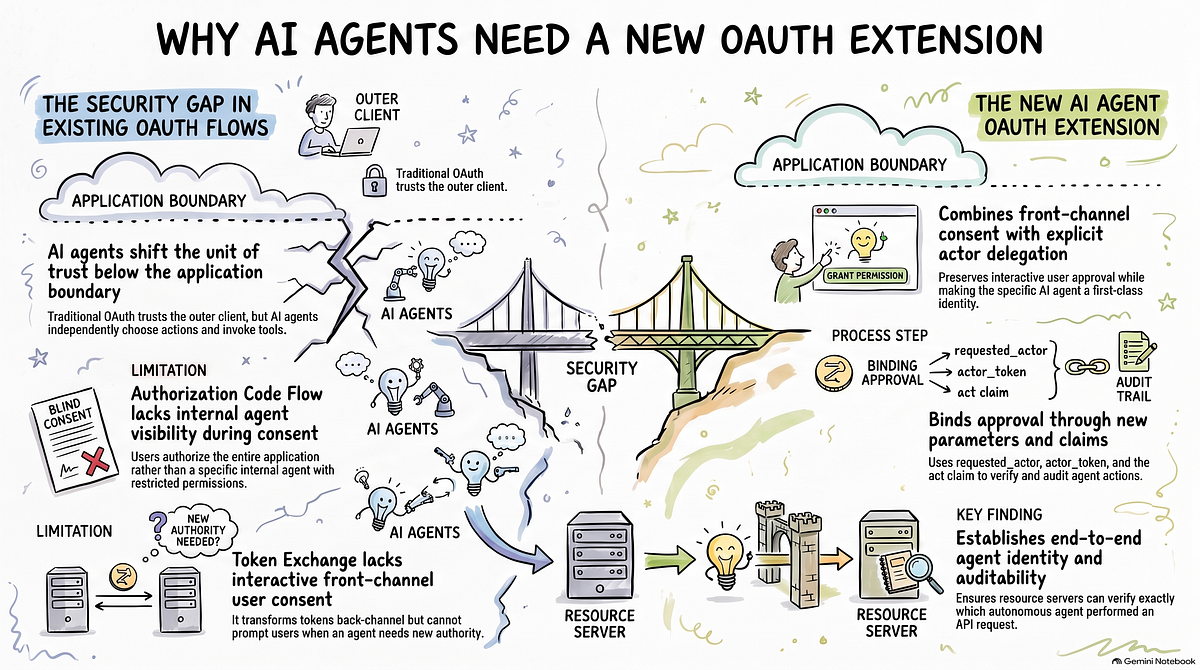
This article explains the OAuth 2.0 Token Exchange flow, its role in secure service-to-service communication, and its significance for AI agent authorization. It clarifies how token exchange addresses security challenges like least privilege and delegation.
What happened
The article describes the OAuth 2.0 Token Exchange protocol, its use cases in service communication, and its application to AI agent authorization. It contrasts delegation and impersonation scenarios, emphasizing security benefits like controlled token forwarding and auditability.
Why it matters
For AI developers and system architects, Token Exchange provides a framework to enforce least privilege and secure delegation, critical for multi-service AI systems. It addresses vulnerabilities in traditional token handling, such as blast radius and trust boundary violations.
- Token Exchange enhances security through controlled delegation and audience-specific tokens.
- Delegation in AI systems requires explicit tracking of both users and acting services.
- OAuth 2.0 Token Exchange is critical for secure AI agent interactions across services.
- Cloud platforms like AWS and Azure leverage token exchange for agent authorization.
The bigger picture
Adopting Token Exchange improves security in AI systems by limiting token usage to specific services and contexts, reducing risks from token leakage or misuse. It supports scalable, auditable authorization for AI agents operating across distributed environments.
The article establishes Token Exchange as a vital component for secure AI agent authorization, addressing key challenges in service communication and delegation while aligning with modern security practices.
Technical details
- RFC 8693 standard for Token Exchange
- Subject_token and actor_token mechanisms
- Claims: sub (subject), aud (audience), act (actor), scope
- OAuth 2.0 grant_type: urn:ietf:params:oauth:grant-type:token-exchange
FAQ
What is OAuth 2.0 Token Exchange?
Token Exchange is an OAuth 2.0 flow that allows a client to exchange one token for another, tailored for specific services or security contexts, improving trust boundaries and access control.
How does delegation differ from impersonation in Token Exchange?
Delegation explicitly identifies both the user (subject) and the acting service (actor), while impersonation only shows the user's identity, hiding the service's role in the request.
Why is Token Exchange important for AI agents?
AI agents require explicit delegation chains to ensure secure, auditable actions across services. Token Exchange enables this by tracking both users and acting systems, preventing unauthorized access.
This summary and analysis were generated with AI from the original article and may contain errors. Read the original for the full story.
Read the full story
Originally published by Towards AI on Oct 10, 2026.
Comments
Sign in to join the discussion.