
Peut-on faire confiance à un tableau de bord IA provenant d’Excel ? Une liste de contrôle d’évaluation
Découvrez comment examiner un tableau de bord IA depuis Excel : définissez le KPI, tracez-le jusqu’aux lignes sources, testez les cas limites et choisissez entre un flux de travail fichier et une solution BI.
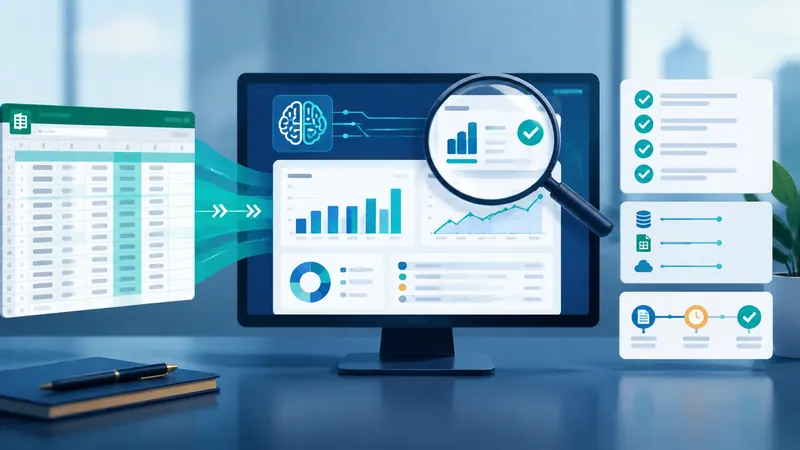
This article provides a verification framework for AI-generated dashboards created from Excel files, emphasizing data accuracy and transparency in AI-driven reporting.
What happened
The article outlines a methodology for verifying AI-generated Excel dashboards by establishing clear KPI definitions, validating data lineage, and testing edge cases to ensure numerical accuracy before sharing results.
Why it matters
For AI developers and data professionals, this guide addresses critical challenges in ensuring trustworthiness of AI-driven analytics, particularly when transitioning from raw data to visualized insights.
- Establish explicit KPI definitions before dashboard creation
- Validate numerical results against source data rows
- Implement edge case testing for data reliability
- Choose appropriate delivery models (file-based vs. BI systems)
- Use AI tools like RowSpeak for verifiable data transformations
The bigger picture
The article highlights the importance of data transparency in AI systems, helping organizations avoid silent calculation errors that can mislead decision-making processes.
The article provides a structured approach to verifying AI dashboards from Excel, emphasizing transparency, data lineage, and rigorous validation to ensure analytical accuracy.
Technical details
- KPI contract structure with five components: source, granularity, filters, formula, and data cutoff
- Data verification workflows involving source file filtering and manual recalculations
- Edge case testing protocols for data integrity checks
- RowSpeak's role in transforming unstructured data into auditable dashboards
FAQ
Why are AI dashboards from Excel prone to errors?
Silent calculation errors can occur due to misdefined KPIs, unhandled edge cases, or incomplete data lineage, leading to visually appealing but numerically incorrect results.
What is a KPI contract?
A structured definition of how a key performance indicator is calculated, including source data, granularity, filters, formulas, and data cutoff dates.
How does RowSpeak contribute to dashboard verification?
RowSpeak transforms unstructured data into auditable dashboards by enforcing explicit KPI definitions and enabling verification against source data.
What edge cases should be tested for data integrity?
Duplicate entries, missing fields, partial periods, and mixed currencies require specific validation protocols to ensure accurate dashboard calculations.
When should organizations use BI systems instead of file-based workflows?
BI systems are preferable when multiple teams need shared definitions, automated updates, or strict access controls are required, unlike file-based approaches.
This summary and analysis were generated with AI from the original article and may contain errors. Read the original for the full story.
Read the full story
Originally published by Excelmatic Blog on Oct 10, 2026.
Comments
Sign in to join the discussion.