
Stop Paying Your LLM to Flip Coins
Stop Paying Your LLM to Flip Coins 9 design patterns for System One models like Jev and Laya, and how they make AI agents faster, cheaper, and safer Here’s an uncomfortable exercise. Open your …
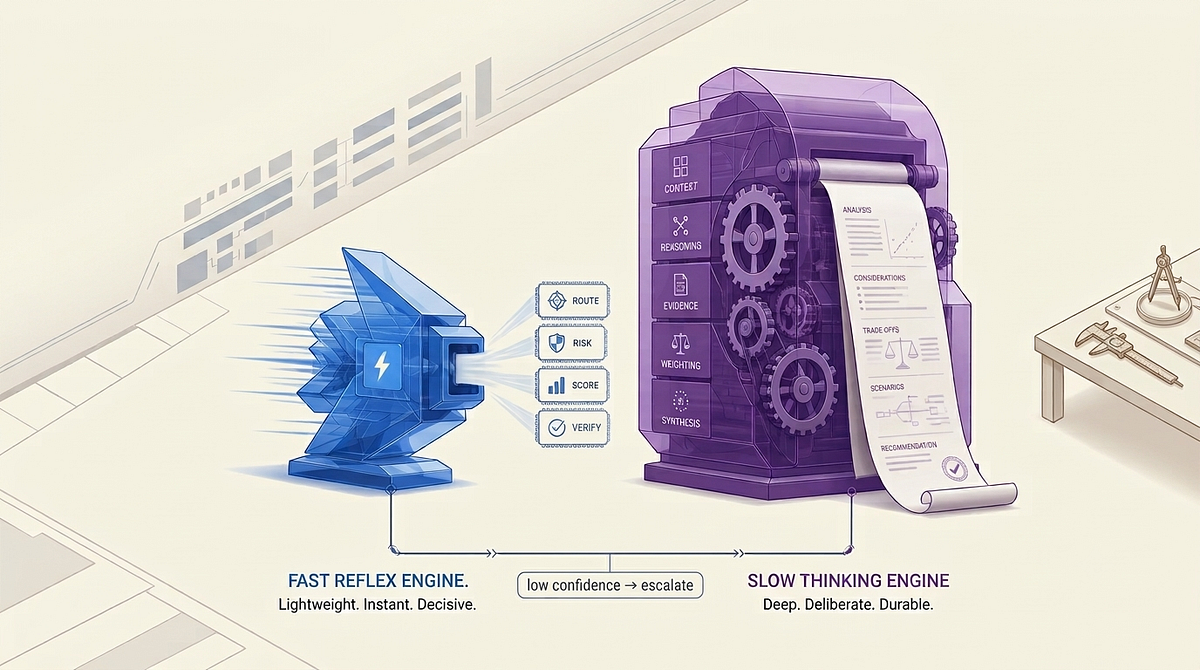
This article introduces 'System One' models like Jev and Laya, which are designed to make AI agents faster, cheaper, and safer by reducing unnecessary LLM calls and improving decision-making efficiency.
What happened
The article discusses the concept of 'System One' models, such as Jev and Laya, which are designed to make AI agents more efficient by reducing the number of LLM calls and improving decision-making. It outlines nine design patterns for implementing these models, including deterministic logic, speculative fan-out, and confidence-gated cascades. The article also highlights the limitations and considerations when using these models in production.
Why it matters
System One models are important for AI developers and system architects because they offer a more efficient and cost-effective way to handle specific, predefined questions in AI agents. By reducing the need for complex parsing and retries, these models can improve the speed and safety of AI systems, making them more practical for real-world applications.
- System One models are designed for specific, predefined questions with typed answers.
- They reduce the need for complex parsing and retries by limiting answers to predefined options.
- System One models can be used as a reflex layer in AI systems, with more complex decisions handled by System Two models.
- The article outlines nine design patterns for implementing System One models in AI agents.
- System One models are intended to be used in conjunction with other models to create more efficient and effective AI systems.
The bigger picture
The practical impact of System One models is that they can reduce the cost and complexity of AI agent systems by minimizing unnecessary LLM calls and improving decision-making efficiency. This can lead to faster, cheaper, and safer AI systems, particularly in applications like fraud detection and customer support.
The article concludes that System One models like Jev and Laya offer a more efficient and cost-effective way to handle specific, predefined questions in AI agents. By reducing the need for complex parsing and retries, these models can improve the speed and safety of AI systems, making them more practical for real-world applications.
Technical details
- System One models take a state and typed questions with predefined answers.
- The three question types are Choice, Score, and Noul.
- Jev is a hosted, closed API with reported latency and cost metrics.
- Laya is an open-source model with a large parameter count and local execution capability.
- System One models are used as a reflex layer in AI systems, with more complex decisions handled by System Two models.
FAQ
What are System One models?
System One models are designed to handle specific, predefined questions with typed answers and probabilities. They are used to reduce the need for complex parsing and retries in AI agents.
What are some examples of System One models?
Jev and Laya are two examples of System One models. Jev is a hosted, closed API, while Laya is an open-source model.
What are the benefits of using System One models?
System One models can reduce the cost and complexity of AI agent systems by minimizing unnecessary LLM calls and improving decision-making efficiency.
What are the design patterns for implementing System One models?
The article outlines nine design patterns for implementing System One models, including deterministic logic, speculative fan-out, and confidence-gated cascades.
What are the limitations of System One models?
System One models are not magic and have limitations, such as difficulty with arithmetic and dates. They are intended to be used as a reflex layer in AI systems, with more complex decisions handled by System Two models.
This summary and analysis were generated with AI from the original article and may contain errors. Read the original for the full story.
Read the full story
Originally published by Towards AI on Sep 30, 2026.
Comments
Sign in to join the discussion.