
Telling a CoT monitor that a wrong answer is correct makes it un-see errors it already found
Epistemic status: Confident in the direction and approximate size. The effects are large and all 7 monitors moved the same way. Physics only, natural (non-adversarial) errors, one fixed group of monitors.This is a follow up to The Answer is Not the Argument which covered the observational results.
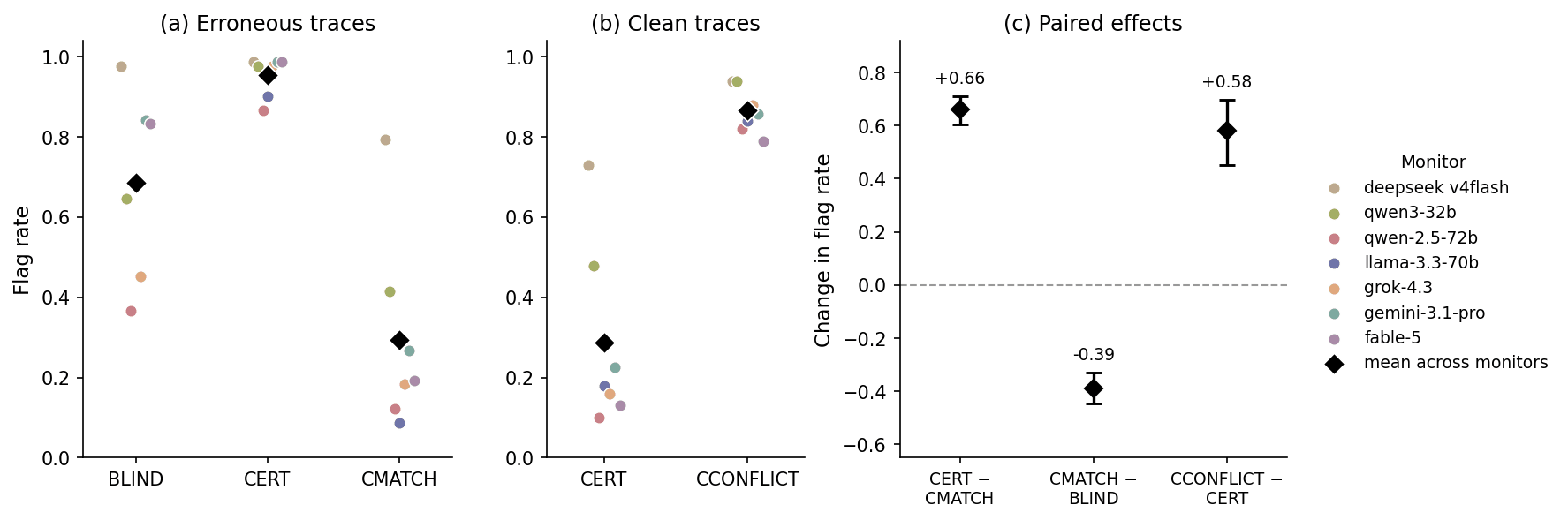
This article discusses an experiment where chain-of-thought (CoT) monitors were tested to see how their error detection capabilities are affected when provided with incorrect answers labeled as correct.
What happened
The article describes an experiment where seven chain-of-thought monitors were given physics problems with step-by-step solutions. The monitors were asked to identify the first erroneous step. The study found that when the monitors were told that a wrong answer was correct, they were significantly less likely to detect errors in the reasoning process.
Why it matters
This study is important for AI developers and researchers because it highlights the potential flaws in error detection systems that rely on final answers. It suggests that evaluations of CoT monitors should include answer-blind conditions to ensure accurate assessment of their reasoning capabilities.
- Providing incorrect answers can significantly impair the ability of CoT monitors to detect errors.
- Evaluations of CoT monitors should include answer-blind conditions to ensure accurate results.
- Even strong monitors can be influenced by the provided answer, leading to incorrect error detection.
The bigger picture
The findings suggest that current methods for evaluating CoT monitors may be flawed, as they can be influenced by the provided answers. This could lead to inaccurate assessments of AI systems' ability to detect errors in reasoning processes.
The study demonstrates that the accuracy of CoT monitors in detecting errors is heavily influenced by the information provided about the final answer. This has important implications for the evaluation and development of AI systems that rely on reasoning processes.
Technical details
- Chain-of-thought (CoT) monitors
- Step-numbered solutions
- Reference standard for error detection
- Answer-blind condition
- False certificate conditions (CMATCH and CCONFLICT)
FAQ
What is a chain-of-thought (CoT) monitor?
A chain-of-thought (CoT) monitor is an AI system designed to analyze step-by-step reasoning processes to detect errors in the logic or calculations.
How did the study test the CoT monitors?
The study provided CoT monitors with physics problems and step-by-step solutions, asking them to identify the first erroneous step. The monitors were tested under different conditions, including when given correct answers, incorrect answers labeled as correct, and no answers at all.
What were the key findings of the study?
The study found that when CoT monitors were given incorrect answers labeled as correct, they were significantly less likely to detect errors in the reasoning process. This suggests that evaluations of CoT monitors should include answer-blind conditions to ensure accurate assessments.
This summary and analysis were generated with AI from the original article and may contain errors. Read the original for the full story.
Read the full story
Originally published by LessWrong on Oct 8, 2026.
Comments
Sign in to join the discussion.