
Tesla’s New Roadster Can Somehow Do Corkscrews in the Air (Without Exploding—Yet)
This engineering marvel / catastrophe-in-the-making will definitely come out in 2028, Tesla CEO Elon Musk promised.
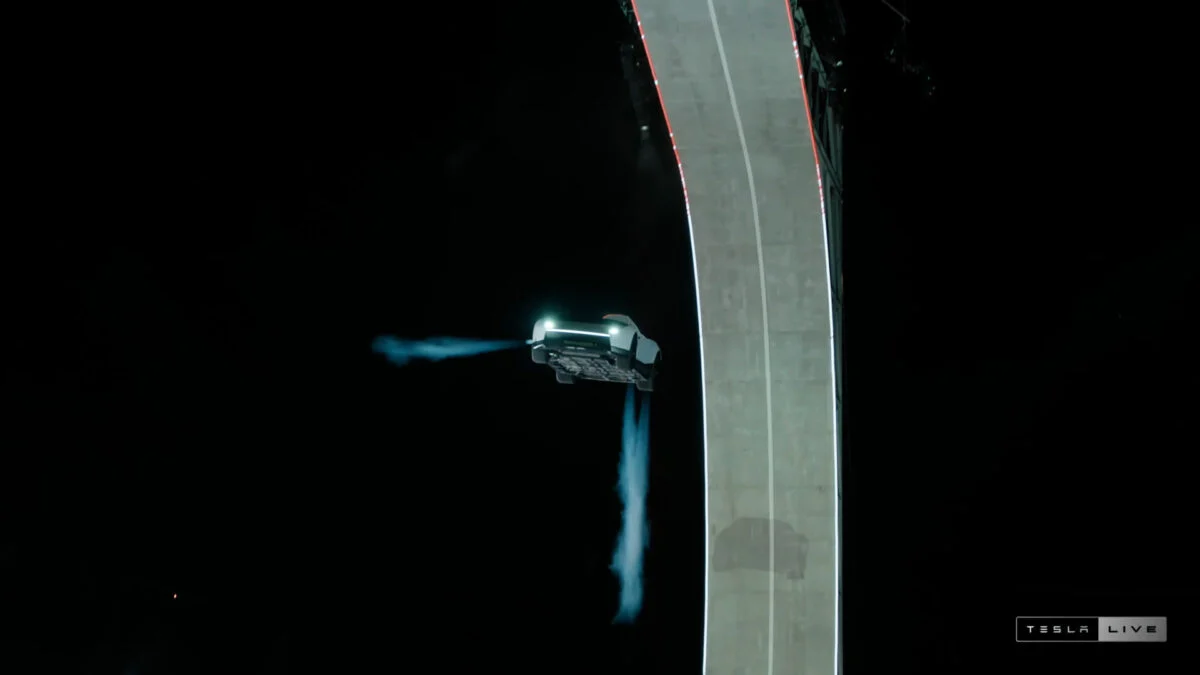
Tesla's new Roadster, unveiled in a dramatic demo, showcases advanced capabilities such as upside-down driving, corkscrewing in the air, and rapid acceleration, all made possible through collaboration with SpaceX and the use of advanced propulsion systems.
What happened
Tesla unveiled a prototype of its new Roadster, demonstrating its ability to perform corkscrewing maneuvers in the air, upside-down driving, and rapid acceleration using advanced propulsion systems developed in collaboration with SpaceX. The demo included a live test of the car's acceleration and a corkscrew maneuver, with no explosions occurring despite the high-speed and high-thrust capabilities.
Why it matters
The Roadster's advanced propulsion and maneuvering capabilities represent a significant leap in automotive engineering, potentially influencing future vehicle design and safety regulations. Its use of compressed air and thrusters could inspire new approaches to vehicle propulsion and mobility, though its practical applications remain unclear.
- The Roadster's propulsion system uses compressed air and thrusters, eliminating the need for traditional fuel.
- The car's ability to perform corkscrewing and upside-down driving highlights advanced engineering and control systems.
- The FAA's classification of such vehicles as aircraft may limit their use in public spaces.
- The Roadster's performance metrics, such as 0-60 mph in under a second, set new benchmarks for automotive speed.
- The project's timeline for production is set for 2028, with limited additional details provided.
The bigger picture
The Roadster's capabilities may lead to new safety regulations and airspace restrictions, as well as inspire future innovations in vehicle propulsion and mobility. However, its practical use in real-world scenarios remains uncertain due to legal and safety concerns.
Tesla's new Roadster represents a bold engineering achievement, combining advanced propulsion systems with dramatic maneuvering capabilities. While its practical applications remain uncertain, the project highlights the potential for future innovations in automotive and aerospace technology.
Technical details
- SpaceX cold-gas thrusters powered by an 'advanced ultra-high pressure air tank'.
- Suction fans generating over 2 Gs of cornering grip for upside-down driving.
- Acceleration to 60 mph in 0.81 seconds using 80 kilonewtons of thrust.
- FAA classification of vehicles rising off the ground as aircraft, affecting airspace usage.
FAQ
What propulsion system does the Tesla Roadster use?
The Tesla Roadster uses SpaceX cold-gas thrusters powered by an 'advanced ultra-high pressure air tank', eliminating the need for traditional fuel.
Can the Tesla Roadster drive upside down?
Yes, the Roadster can drive upside down using suction fans that generate over 2 Gs of cornering grip.
How fast can the Tesla Roadster accelerate?
The Roadster can accelerate to 60 mph in under a second, with a live test achieving it in 0.81 seconds.
What are the FAA regulations regarding the Roadster?
The FAA classifies any vehicle rising off the ground as an aircraft, which may restrict the Roadster's use in public airspace.
When will the Tesla Roadster be available?
The Roadster is set to enter production in 2028, with limited additional details provided beyond that timeline.
This summary and analysis were generated with AI from the original article and may contain errors. Read the original for the full story.
Read the full story
Originally published by Gizmodo — AI on Oct 16, 2026.
Comments
Sign in to join the discussion.