
The Problem With“Doomers” and “Optimists”
In the modern zeitgeist, we have begun to throw around labels to describe different outlooks about the future, with flavors like “doomer” and “optimist.” The “doomers” are framed as anti-technological progress, and the “optimists” as rational, pro-progress hopefuls.
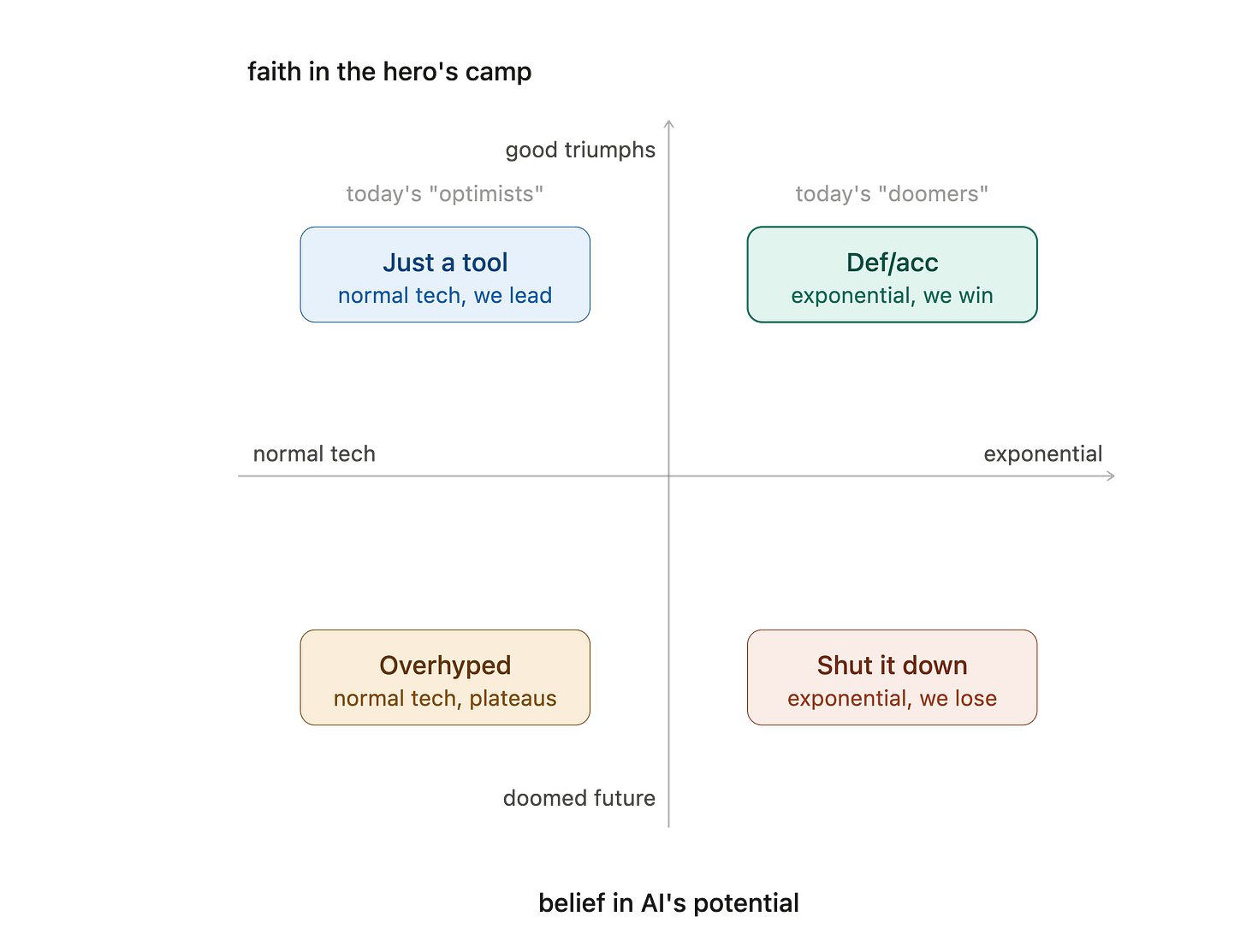
This article challenges the common labeling of AI-related perspectives as 'doomers' or 'optimists,' proposing a two-axis framework to better categorize beliefs about AI's potential and human agency.
What happened
The article presents a taxonomy of beliefs about AI's future, arguing that the terms 'doomer' and 'optimist' are misleading. It introduces a two-axis framework to categorize perspectives on AI's potential and human agency, discussing various camps such as defense accelerationists, double optimists, and capability pessimists.
Why it matters
Understanding these nuanced perspectives helps AI developers and policymakers address risks and opportunities more effectively, avoiding oversimplified labels that hinder productive dialogue.
- Labels like 'doomer' and 'optimist' often misrepresent complex AI-related beliefs.
- The two-axis framework provides a more accurate way to categorize perspectives on AI's future.
- Proactive risk management (e.g., defense acceleration) is critical for addressing AI challenges.
- Historical examples show the value of addressing potential risks before they materialize.
- Understanding different camps fosters better collaboration among AI stakeholders.
The bigger picture
The article encourages a more precise discussion of AI risks and solutions, emphasizing the need for proactive measures and recognizing diverse stances in the AI community.
The article advocates for moving beyond simplistic labels to engage in nuanced discussions about AI's potential and risks, emphasizing the importance of proactive strategies and diverse perspectives.
Technical details
- Two-axis model: X-axis = belief in AI's exponential capability; Y-axis = belief in human/Good actors' capabilities.
- Def/acc (defense acceleration): Advocating for accelerating AI development to create protective measures against risks.
- Yudkowsky camp: Focus on AI alignment risks, arguing that superintelligent AI could lead to existential catastrophe.
- Bostromian perspective: Emphasis on preventing 'astronomical waste' by ensuring AI's positive long-term impact.
FAQ
What is the two-axis model for categorizing AI beliefs?
The model measures belief in AI's exponential capability (X-axis) and belief in human/Good actors' capabilities (Y-axis), creating four quadrants for different perspectives.
Why are some 'doomers' actually considered optimists in this framework?
Because 'doomers' may be highly optimistic about AI's potential but concerned about risks, advocating for proactive measures like defense acceleration.
What is 'def/acc' and why is it important?
Defense acceleration (def/acc) refers to accelerating AI development to create protective measures against risks, reflecting a proactive approach to managing AI's dangers.
How does the article address AI alignment risks?
It acknowledges the Yudkowsky camp's focus on alignment as a critical challenge, while emphasizing the need for both technological and human-centric solutions.
What historical examples are used to support the article's arguments?
The article references nuclear weapons strategy, Y2K preparedness, and past technological risks to illustrate the value of proactive risk management.
This summary and analysis were generated with AI from the original article and may contain errors. Read the original for the full story.
Read the full story
Originally published by LessWrong on Oct 10, 2026.
Comments
Sign in to join the discussion.