
Three Pieces of Evidence that the NLA Reconstructor Does Not Read Semantics or Syntax
TL;DRThe autoreconstructor (AR) in a natural language autoencoder (NLA) is the entire argument for the validity of the method, and at present is poorly understood.The AR does not condition strongly on English grammar or semantics.
This article presents findings from an analysis of the autoreconstructor (AR) in a natural language autoencoder (NLA), questioning its ability to understand semantic meaning and syntax in English. The study provides evidence that the AR is more influenced by the format of the verbalization than by semantic content.
What happened
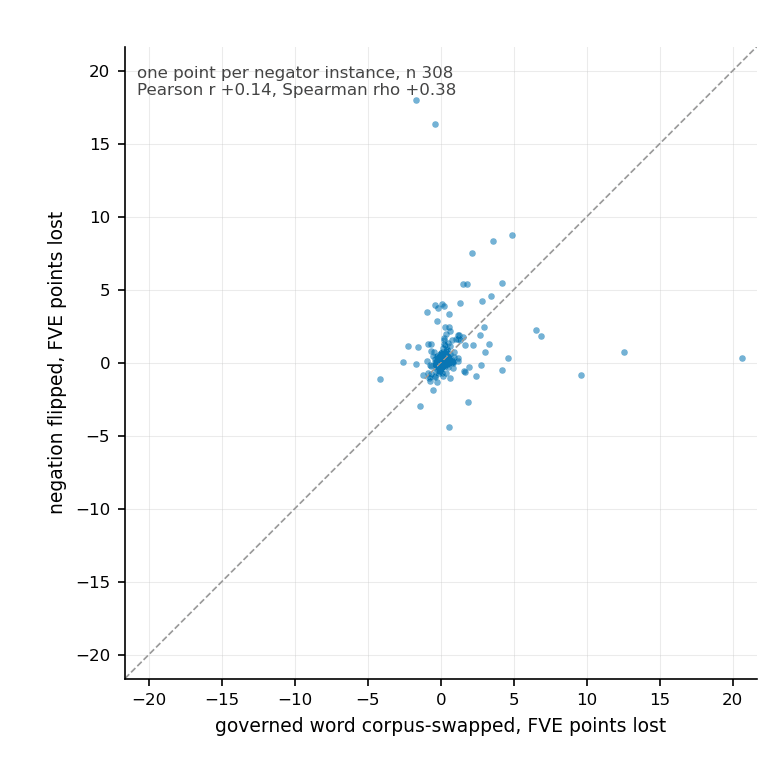
The article presents an analysis of the autoreconstructor (AR) in a natural language autoencoder (NLA), revealing that it does not strongly condition on English grammar or semantics. The study provides three pieces of evidence: the AR's limited response to negation, lack of correlation between syntactic dependencies and interaction strength, and the minimal impact of deleting content words like nouns and verbs.
Why it matters
Understanding how NLAs process and reconstruct language is crucial for developing reliable AI systems. The findings suggest that current NLAs may not effectively capture semantic meaning, which has implications for their use in tasks requiring deep language understanding.
- The AR in NLAs may not effectively capture semantic meaning, relying more on the format of the verbalization.
- Further research is needed to understand how NLAs encode and reconstruct semantic information.
- The study's findings challenge the assumption that NLAs can reliably capture and represent semantic content.
- The results emphasize the importance of evaluating the semantic capabilities of AI models in practical applications.
- Understanding the limitations of NLAs can help in developing more robust and reliable AI systems.
The bigger picture
The study's findings suggest that current NLAs may not effectively capture semantic meaning, which could affect their reliability in applications requiring deep language understanding. This highlights the need for further research into improving the semantic fidelity of such models.
The article concludes that the autoreconstructor in natural language autoencoders does not strongly condition on English grammar or semantics, suggesting it is more influenced by the format of the verbalization. The findings highlight the need for further research into the semantic capabilities of NLAs and their practical implications.
Technical details
- Autoreconstructor (AR): The component of the NLA responsible for reconstructing activations from verbalizations.
- Natural Language Autoencoder (NLA): A model that encodes and decodes language, with the AR as its core component.
- FVE (Fraction of Variance Explained): A metric used to measure the impact of edits on the reconstructed activation.
- Dependency arcs: Syntactic relationships between words in a sentence, analyzed using NLP tools like Stanza.
- Ablation strategies: Techniques to evaluate the impact of modifying specific words or phrases in a verbalization.
FAQ
What is the autoreconstructor (AR) in a natural language autoencoder (NLA)?
The autoreconstructor (AR) is the core component of an NLA responsible for reconstructing activations from verbalizations. It is central to the validity of the NLA method, but its understanding is currently limited.
What evidence does the article present about the AR's sensitivity to syntax and semantics?
The article presents three pieces of evidence: the AR's limited response to negation, lack of correlation between syntactic dependencies and interaction strength, and the minimal impact of deleting content words like nouns and verbs.
How does the study measure the impact of edits on the AR's performance?
The study uses FVE (Fraction of Variance Explained) as a metric to measure the impact of edits on the reconstructed activation. It compares the FVE loss from different types of interventions, such as flipping negations or deleting words.
What are the implications of the study's findings for AI systems using NLAs?
The findings suggest that current NLAs may not effectively capture semantic meaning, which could affect their reliability in tasks requiring deep language understanding. This highlights the need for further research into improving the semantic fidelity of such models.
What future work is suggested by the study?
The study suggests future work should aim to disprove the hypothesis that the AR conditions mostly on format or quantify how much format contributes relative to semantics.
This summary and analysis were generated with AI from the original article and may contain errors. Read the original for the full story.
Read the full story
Originally published by LessWrong on Oct 9, 2026.
Comments
Sign in to join the discussion.