
Why humanoid robot demos still fail the generalization test
How better data and human judgment can help robots move beyond demos toward reliable real-world performance. The post Why humanoid robot demos still fail the generalization test appeared first on The Robot Report.
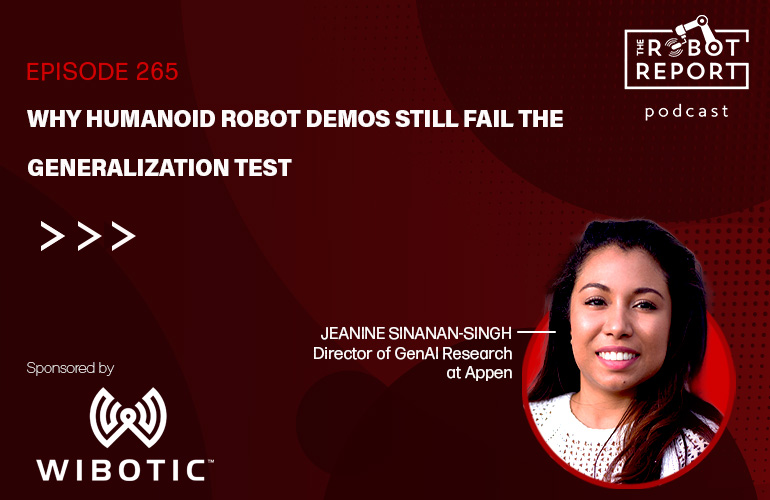
The article explores challenges in generalizing humanoid robot performance from controlled demonstrations to real-world applications, emphasizing the role of human oversight and data quality.
What happened
The article discusses insights from Jeanine Sinanan-Singh, who highlights the limitations of humanoid robot demos and the need for better data and human judgment to achieve reliable real-world performance. It also covers broader industry news, including leadership changes and robotics advancements.
Why it matters
Understanding the limitations of current robotic systems helps developers address critical challenges in creating adaptable, reliable AI-driven robots for practical applications.
- Human oversight is essential for improving robot generalization.
- High-quality datasets and evaluation frameworks are critical for AI training.
- Current demos often fail to reflect real-world complexity.
- Addressing generalization challenges is key to advancing robotics.
The bigger picture
The article underscores the importance of refining training processes to bridge the gap between experimental robot demonstrations and scalable real-world deployment, which could influence future research and development strategies.
The article highlights persistent challenges in humanoid robotics, emphasizing the need for improved training methods and human-AI collaboration to achieve reliable real-world performance.
Technical details
- Agentic evals (evaluations of autonomous agents)
- Reinforcement learning (RL) environments
- Human-in-the-loop training methodologies
- Dataset design for post-training AI models
FAQ
Why do humanoid robot demos fail to generalize?
Demos often lack the robustness and adaptability required for real-world environments, which involve unpredictable variables not present in controlled settings.
What role do humans play in robot training?
Humans in the loop provide critical judgment and data refinement to improve the reliability and generalization of robotic systems.
What are agentic evaluations?
Agentic evaluations assess the performance of autonomous agents (like robots) in complex, dynamic environments to identify gaps in their decision-making and adaptability.
This summary and analysis were generated with AI from the original article and may contain errors. Read the original for the full story.
Read the full story
Originally published by The Robot Report on Oct 9, 2026.
Comments
Sign in to join the discussion.