
Why teams are dropping cross-platform frameworks in 2026, and when your team should follow
Shopify rebuilt its Shop app natively in 12 weeks because agents cut the cost of writing features twice. When that applies to your team, and when it does not.
This article examines the growing trend of companies moving away from cross-platform frameworks like React Native to native development (Swift/Kotlin) in 2026, driven by AI coding agents reducing duplication costs. It analyzes Shopify's and GitHub's transitions and provides decision frameworks for teams.
What happened
In 2026, Shopify transitioned its Shop app from React Native to native Swift/Kotlin development, citing AI agents that reduced feature implementation costs. GitHub also moved away from CSS-in-JS for performance reasons. The article details technical tradeoffs, performance metrics, and decision frameworks for teams considering similar transitions.
Why it matters
The shift highlights AI's growing role in software development economics. Teams must weigh performance gains against maintenance costs when choosing between cross-platform and native approaches, while also addressing technical debt in legacy systems.
- AI agents reduce but don't eliminate the cost of native development
- Performance gains vary by platform and implementation
- Headless business logic is critical for effective AI-assisted migrations
- CSS-in-JS adoption is declining in favor of static styling solutions
- Teams should evaluate native transitions through controlled proof-of-concept projects
The bigger picture
The trend reflects AI's impact on development workflows, with teams prioritizing performance and platform-specific capabilities. It also highlights ongoing challenges in maintaining cross-platform parity and managing technical debt.
The article demonstrates how AI tools are reshaping mobile development decisions, with companies like Shopify and GitHub prioritizing performance and platform capabilities over cross-platform convenience. It provides a framework for evaluating when and how to transition from cross-platform frameworks.
Technical details
- AI agents enabled code migration workflows (e.g., Pi coding agent extension)
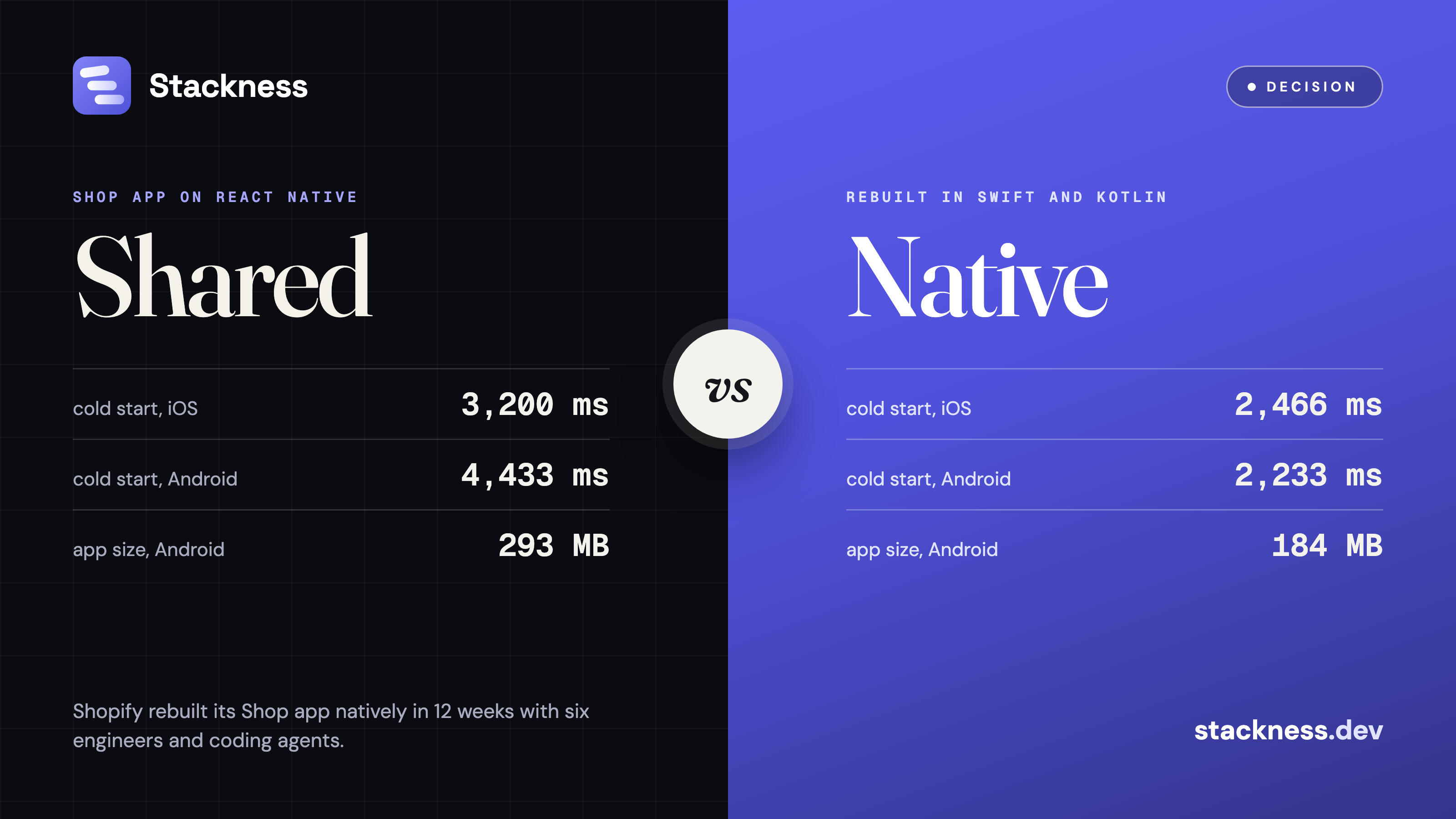
- Cold start time improvements: 23% faster iOS, 50% faster Android
- Session stability increased from 99.5% to 99.95%
- CSS Modules implementation reduced server render times by 55%
- Kotlin Multiplatform allows shared business logic with native UIs
FAQ
Why is Shopify moving away from React Native?
Shopify cites AI agents reducing the cost of writing features for two platforms, making native development more cost-effective despite initial migration efforts.
What role do AI coding agents play in these transitions?
AI agents enable faster code migration and feature implementation, but require headless business logic and rigorous code review processes to maintain quality.
When should teams avoid moving to native code?
Teams should maintain React Native if they rely on over-the-air updates, have a TypeScript-focused team unable to review native code, or haven't adopted the New Architecture.
What performance improvements did Shopify achieve?
Shopify reported 23-50% faster cold starts, 10x fewer crashing sessions, and 109MB smaller Android app size after native migration.
How is GitHub improving performance without AI agents?
GitHub reduced server render times by 55% by switching from CSS-in-JS to CSS Modules, focusing on static styling solutions for better performance.
This summary and analysis were generated with AI from the original article and may contain errors. Read the original for the full story.
Read the full story
Originally published by Stackness Blog on Oct 10, 2026.
Comments
Sign in to join the discussion.