
Xi'an Jiaotong University Simulates 33-Nozzle Rocket Plumes on 6.774 Trillion Cells With Sugon 8000
A Xi'an Jiaotong University team ran a 6.774-trillion-cell simulation of 33 interacting rocket plumes on tens of thousands of domestic GPUs, reaching 99.01% weak-scaling efficiency.
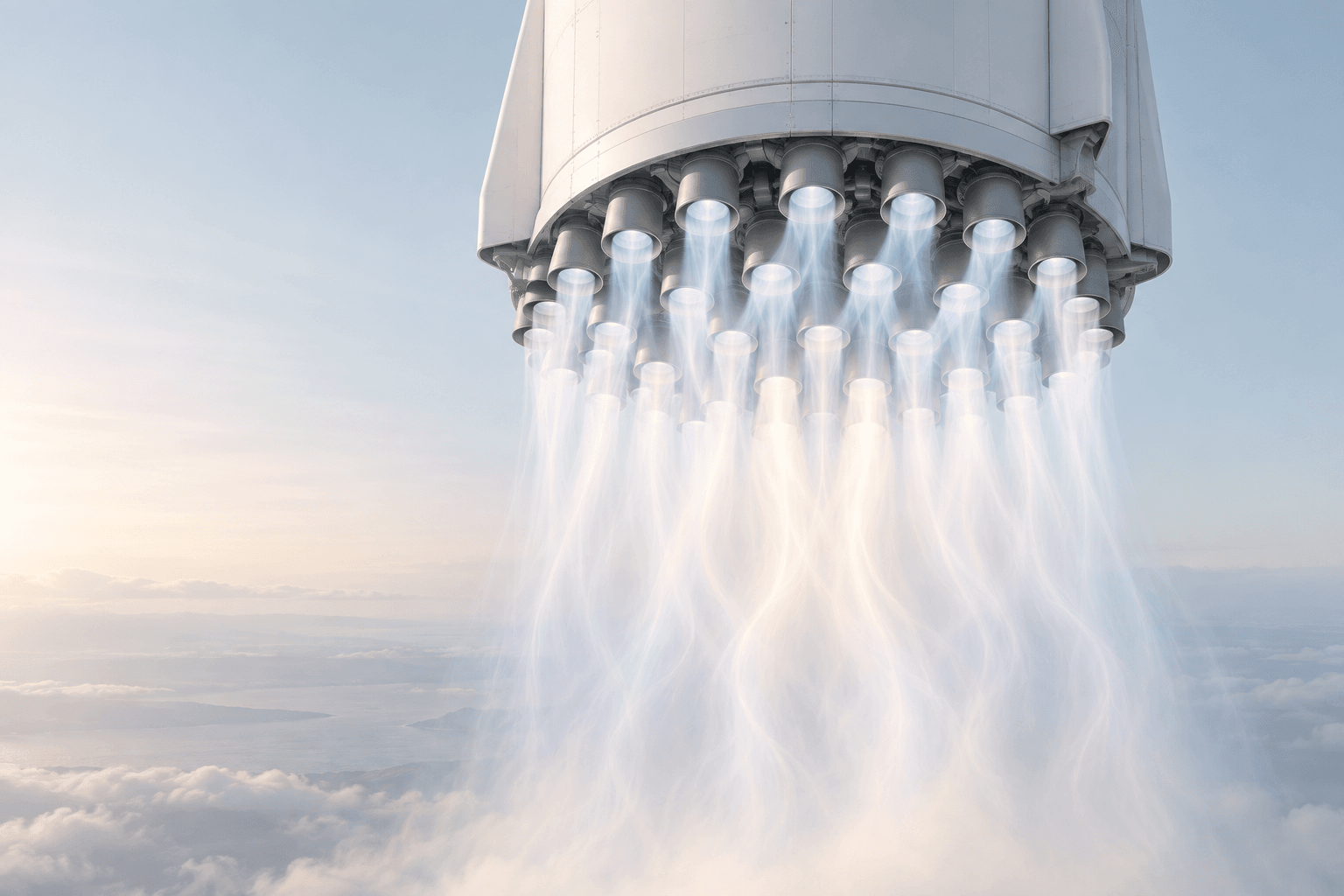
A research team at Xi'an Jiaotong University has conducted a high-fidelity simulation of a 33-nozzle rocket engine's exhaust plumes using 6.774 trillion grid cells on Sugon's 8000 heterogeneous computing platform, achieving remarkable weak-scaling efficiency.
What happened
A team at Xi'an Jiaotong University ran a high-fidelity simulation of a 33-nozzle rocket engine's exhaust plumes using 6.774 trillion grid cells on Sugon's 8000 platform. The simulation achieved 99.01% weak-scaling efficiency and used a space-time coupled WENO-GKS method to improve performance. The work highlights the importance of simulating rocket plumes for reusable rocket design and thermal protection.
Why it matters
The simulation provides critical insights into the complex interactions of rocket plumes, which are essential for designing reusable rockets. It helps engineers analyze pressure fluctuations, thermal protection, and structural integrity, reducing the need for expensive physical tests.
- High-fidelity simulations are critical for understanding rocket plume interactions.
- Efficient computational methods like WENO-GKS improve simulation performance.
- Domestic supercomputing platforms like Sugon 8000 are vital for such complex simulations.
- Simulations reduce the need for expensive physical tests and provide detailed data for design improvements.
- The work has implications for both rocket design and AI-based modeling of fluid dynamics.
The bigger picture
The simulation enables more accurate analysis of rocket plume interactions, aiding in the design of reusable rockets and thermal protection systems. It also supports the development of AI-based models for linking design parameters to flow responses.
The simulation of 33-nozzle rocket plumes on Sugon's 8000 platform represents a significant advancement in computational fluid dynamics and rocket design, offering insights into complex interactions that are difficult to observe through physical testing.
Technical details
- 774 trillion grid cells used for simulation.
- Space-time coupled WENO-GKS method for time integration.
- Structure-of-arrays data layout and operator fusion to reduce memory access.
- Sugon 8000 platform with domestic GPUs and high-speed networking.
- Grid-update throughput of 34.029 trillion cell updates per second.
FAQ
What was the scale of the simulation?
The simulation used 6.774 trillion grid cells to model the exhaust plumes of a 33-nozzle rocket engine array.
What computing platform was used?
The simulation was conducted on Sugon's 8000 heterogeneous computing platform, which uses tens of thousands of domestic GPUs.
What method was used for time integration?
The team used the space-time coupled WENO-GKS method, which improved computational efficiency by reducing memory traffic.
What is the significance of the simulation?
The simulation helps analyze pressure fluctuations and thermal protection challenges in rocket design, reducing the need for expensive physical tests.
What are the future plans for the research?
The team plans to add real geometries and engine operating conditions to build validated flow data, which will be used for AI-based models linking design parameters to flow responses.
This summary and analysis were generated with AI from the original article and may contain errors. Read the original for the full story.
Read the full story
Originally published by Pandaily on Oct 4, 2026.
Comments
Sign in to join the discussion.