Why lawyers use Claude instead of legal AI, and where it breaks
For AI-fluent lawyers, the real rival to legal AI is a Claude setup they built themselves. Why they stay, where it breaks, and what legal AI must beat.
14 stories
For AI-fluent lawyers, the real rival to legal AI is a Claude setup they built themselves. Why they stay, where it breaks, and what legal AI must beat.
Fake AI citations went from curiosity to a docket of thousands. AI client confidentiality is on the same curve. The triggers, our forecast and four controls.
Plain Claude is enough for a lot of legal work. We counted which law Claude's public legal plugins are written around, and what you would build yourself for Gulf law.
We asked four frontier models for court judgments backing an article that doesn't exist. Two declined. Two named 16 between them. Here are the five tests.
Colombia fined a lawyer for AI-invented case law. El Salvador imposed no sanction on a citizen. A Mexican court calls AI "recommendable". We read the rulings.
We ran TypeSafe's Jev across our legal AI stack for under $0.20. It reranks statutes well. It also scored fabricated citations higher than honest ones.
We put Opus 5.5, Opus 5 and Fable 5.1 through ten lawyer-grade prompts and 120 blind verdicts. They finished four verdicts apart, in a loop. Only price separated them.
We tested the legal AI market instead of reading about it. 65% of vendors are a prompt layer over somebody else's model, and 3% train on legal data.
Microsoft's new AI code of conduct names an Operator tier and puts every professional duty there. Across 38 pages, "lawyer" appears zero times. Your firm is the Operator.
We ran GPT-6 Astra against 41 real legal questions, alongside Claude Opus 5 and GPT-5.6 Luna Pro. Every model we tested got Saudi and Egyptian law wrong while citing the correct article, the failure no citation checker catches.
84% of chief legal officers now report to their CEO. The seat moved to where decisions get made, and what legal hands over mostly did not move with it.
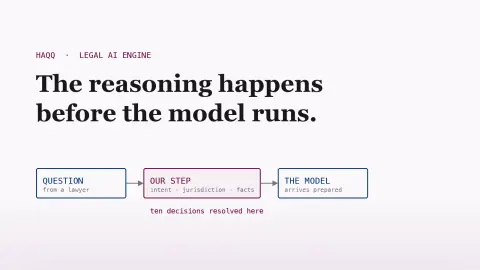
Most legal AI sends your prompt straight to a general model. The real work happens before that. Here is the architecture, and four questions that test any vendor for it.
Regulation (EU) 2026/1744 entered into force on 27 July 2026. High-risk duties moved to December 2027 and August 2028, and the 2 August 2026 transparency deadline did not move. Every change, and what it means for a firm that uses AI.
An independent evaluator ran HAQQ through 61 hard legal tasks in 21 jurisdictions, twice. It passed 27.0% overall, and 5.9% on the hardest subset against 1.1% for the average legal AI. Full numbers inside.
Showing 14 of 14 stories
You're all caught up.
Get the top AI news and tools straight to your inbox every week.
Weekly · AI news
Join 15,000+ AI enthusiasts