Know a great AI tool or AI news source? Submit it to AiByts

Database

42 stories

Stories

  • Open Source DocumentDB 1.0 Reaches General Availability

    DocumentDB 1.0 is the first generally available release of the open source, MIT-licensed document database built on PostgreSQL, with compatibility for the MongoDB wire protocol. Most MongoDB drivers, tools, and queries work without changes. By Renato Losio

    InfoQ - AI/ML/Data3 min read
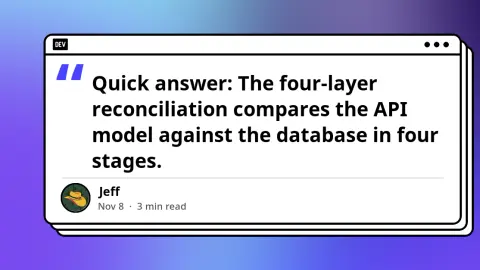
  • The Four-Layer Reconciliation Explained

    Quick answer: The four-layer reconciliation compares the API model against the database in four stages. Observed reads the live tables and enforced keys, Modeled assigns per-table status with field diffs and impacted operations, Proposed builds an ordered additive migration plan with blockedBy, and…

    Dev.to AI4 min read
  • Open Source pg_vectorsearch Brings More Scalable Vector Search to PostgreSQL

    Tiger Data has released pg_vectorsearch, an open source PostgreSQL extension for vector similarity search, currently in alpha. Its PRISM index uses data partitioning and compression instead of the graph-based approach used by pgvector’s HNSW index, reducing memory requirements and index build…

    InfoQ - AI/ML/Data4 min read
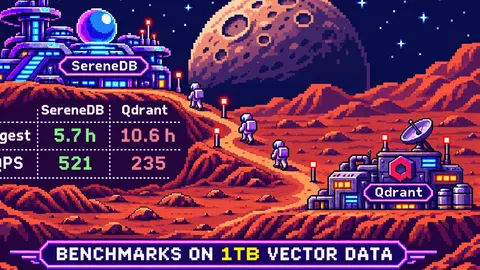
  • SereneDB vs Qdrant: benchmarks on 247 million vectors

    Qdrant benchmarks on 247 million vectors: SereneDB was faster in 32 of the 33 rows both engines answer, by 1.3× to 14×. The same HNSW build in both, eleven filter cases and k up to 1000 on one machine, plus a 10M run in RAM.

    SereneDB Blog21 min read
  • The State of Serene, October 2026

    Issue #5: SereneDB replicates from PostgreSQL, takes online backups, runs scheduled jobs and answers drivers' catalog queries 11x faster.

    SereneDB Blog21 min read
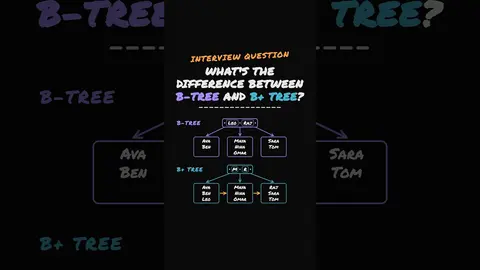
  • Interview: B-Tree vs B+ Tree

    In a standard B-tree, keys and row pointers are stored at every level, including the root and middle boxes. While this occasionally allows a lookup to stop early at the top, almost all records in massive databases sit at the bottom anyway.

    KodeKloud
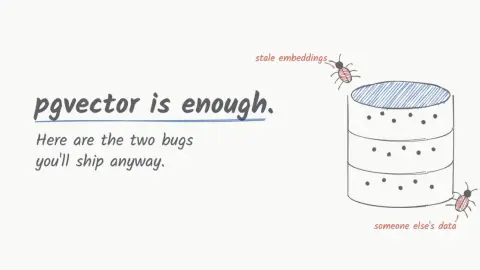
  • pgvector is enough. Here are the two bugs you'll ship anyway.

    "Do we need Pinecone for this?" If you're adding AI search to an app in 2026, someone on your team has asked this. The internet's answer is pretty settled by now: no, keep your embeddings in Postgres with pgvector. I agree. I also work at Nhost, a backend built on Postgres, so yes, I'm biased.

    Dev.to AI5 min read
  • Agents are breaking AI economics, and the fix starts in the data layer

    When companies talk about the cost of artificial intelligence, the conversation almost always starts with models: which one to use, what it costs per million tokens, and whether a smaller model is “good enough.” That made sense when AI meant a chatbot.

    SiliconANGLE7 min read
  • AI coding agent on production database? True or False?

    Should you give your AI coding assistant direct access to your live production database? Before you hand over those keys, Martin Omander, Developer Advocate at Google, shares why doing this is a massive risk, and how you can fix it.

    Google Cloud Tech
  • dbForge 2026.2 Makes Its AI SQL Assistant Free: Here’s What Developers Get

    dbForge 2026.2 is out, and for anyone who writes SQL every day the headline is simple: dbForge AI Assistant now has a free Express edition. You can generate, explain, fix, and optimize SQL with AI directly inside your dbForge tool, working against your actual schema, without buying a subscription…

    Dev.to AI5 min read
  • The State of Serene, September 2026

    Issue #4 of The State of Serene: faster search on every core and from a cold cache, regex and fuzzy search that always answer, text analyzers as expressions, HNSW, the docs inside the binary, OpenTelemetry ingestion, faster time histograms, MATCH_RECOGNIZE, spatial and AI functions.

    SereneDB Blog26 min read

Showing 18 of 42 stories

Load more stories
AiByts Weekly Brief

Get the top AI news and tools straight to your inbox every week.

Weekly · AI news

Join 15,000+ AI enthusiasts