White Label Fintech Solution
A modern fintech platform involves more than a user interface. It requires a combination of application layers, integrations, user management, transaction workflows, monitoring, and administrative controls.
6 stories
A modern fintech platform involves more than a user interface. It requires a combination of application layers, integrations, user management, transaction workflows, monitoring, and administrative controls.
On October 8, 2026, this card came up in an ai i use to Explore feed: Memory & Storage, four stocks, all four down. Micron -4.79%, SanDisk -4.90%, Seagate -4.05%, Western Digital -2.99%. Real order flow across the group: -$1.68B. What each line on the card is for Sector market cap: $1.72T.
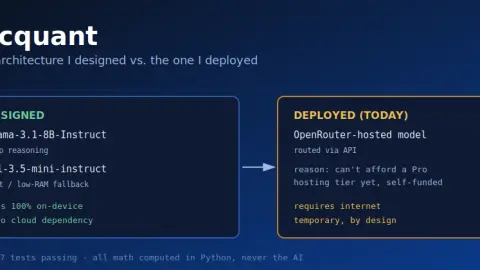
I participated in a competition and it gave me an insight into something interesting and it led me to build Vicquant. An offline financial advsior app but when i was building it, i ran into a problem and and this aid me in solving real world problem and be innovative for the time being.
[Body = canonical page adapted: H1, short answer, what shipped table, Sentinel-as-gate section, money plumbing, live gate receipts, DIY 5 steps, honest caveats. Full text on canonical: https://scriptmasterlabs.com/meta-muse-small-business]
Three regulators answered "should AI agents authorize payments" in one day at GFF 2026 (September 25, 2026), and a Swiss bank's AI chief said the same thing a day earlier. The answer: no — not on their own. Agents may determine intent; a separate authorization layer decides whether money moves.
Financial applications often contain a lot of data, but more data does not automatically make a product easier to understand. Credit information is a good example. A credit profile can contain accounts, balances, payment information, utilization, dates and enquiries.
Showing 6 of 6 stories
You're all caught up.
Get the top AI news and tools straight to your inbox every week.
Weekly · AI news from Dev.to AI
Join 15,000+ AI enthusiasts