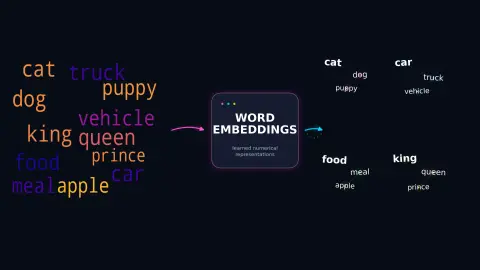
How Do Word Embeddings Capture Relationships Between Words?
Understanding how words become related in a learned vector space The post How Do Word Embeddings Capture Relationships Between Words? appeared first on Towards Data Science.
74 stories
Understanding how words become related in a learned vector space The post How Do Word Embeddings Capture Relationships Between Words? appeared first on Towards Data Science.
Google has introduced support for local models in the Antigravity SDK, enabling developers to build and execute agentic workflows directly on their own machines, while retaining the flexibility to mix in cloud-based models for higher-level tasks.
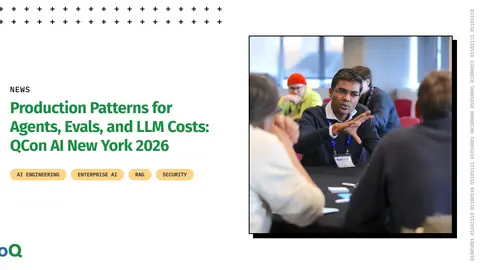
Once AI is in production, code arrives faster than it can be reviewed, token costs rise, evals have to be good enough to act on, and agents need permissions and guardrails. QCon AI New York 2026 (December 15-16) has confirmed sessions from engineers sharing how they handle these constraints.
A new model called Jev is built for this kind of job. You give it the ticket and the possible answers, and it returns a choice with a probability, nothing else. A startup called TypeSafe AI released it on September 15.
OpenAI founding member Andrej Karpathy, who joined Anthropic in May, thinks most of the world has little idea of what The post Andrej Karpathy says only 5,000 people have seen what AI can really do appeared first on The New Stack.
Researchers from Meta, MIT, and the University of Washington introduce Context Language Models (CLMs), a new approach that enables language models to manage and edit their own context rather than relying on predefined mechanisms for summarization, compression, and information retrieval, reporting…
A one-line formula for how often an LLM's top token flips, and why identical completions fall apart after about a hundred tokens The post Why Temperature 0 Isn't Deterministic appeared first on Towards Data Science.
I’m Matt Burns, Chief Content Officer at Insight Media Group. Each week, I round up the most important AI developments, The post Elon Musk’s Grok Bot will pick Claude over Grok when it’s better. One-model loyalty is dead. appeared first on The New Stack.
Google has released Android Bench 2.0, a major update to its benchmark framework for evaluating AI models and agents on Android development tasks. The update introduces long-horizon tasks (LHTs), agent-based evaluation, and continuous scoring to better assess performance on complex, multi-step…
The AI industry has enthusiastically embraced the language of open source, even as some of its most prominent “open” models The post “Don’t use ‘open weight’ and ‘open source’ interchangeably”: Percona CEO on why AI terminology matters appeared first on The New Stack.
Tuning Jev as a Risk Judge: A Decision Model vs. Two Cost-Effective LLMs and When the Hybrid with Reasoning Makes Things Worse
A New System one model from Strands labsContinue reading on Towards AI »
Anthropic launched Sonnet 5.5 six days after Opus 5.5. The company says it scores 70.6% on Terminal-Bench 4.0, ahead of The post Claude Sonnet 5.5 vs. Opus 5.5: 42% cheaper and perfect on every run appeared first on The New Stack.
During its recent “Birthday Week”, Cloudflare announced Clef, a set of open-weight AI models designed to choose between predefined options rather than generate text. Cloudflare released 9B- and 27B-parameter models, along with a platform for adapting them to specific decision-making tasks.
When David Robinson joined OpenAI in May 2023, the day after Sam Altman first testified before the Senate, the company’s The post OpenAI’s former safety lead says it’s shipping “new capability and risk every Tuesday” appeared first on The New Stack.
OpenAI launched GPT-6.1 Sol on September 29, just a week after it launched GPT-6 Sol. OpenAI marketed 6.1 as an The post GPT-6.1 Sol vs. GPT-6 Astra: Same accuracy at 18% of the cost appeared first on The New Stack.
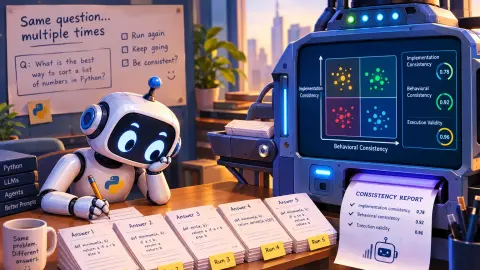
Mapping structural variance against execution outputs to estimate coding agent reliability without ground truth. The post The Consistency Quadrant: A Visual Guide to LLM Reliability appeared first on Towards Data Science.
Smaller Model, Better Memory: Why Qwen2.5-1.5B Outperforms 3B (And Our 4 Hypotheses) Christopher Alberto Hamonangan This article is based on our recent research paper, ‘SRRM: A …
Showing 18 of 74 stories
Load more storiesGet the top AI news and tools straight to your inbox every week.
Weekly · AI news
Join 15,000+ AI enthusiasts