
LLM-as-a-Judge Bug: Our Judge Read a Fifth of Each Answer
A fix scored +5.1 points on our agent eval. Up to half of that came from a bug: our LLM judge only saw the end of each answer. How rejudging saved runs caught it.
Browser Use Blog5 min read
31 stories
A fix scored +5.1 points on our agent eval. Up to half of that came from a bug: our LLM judge only saw the end of each answer. How rejudging saved runs caught it.
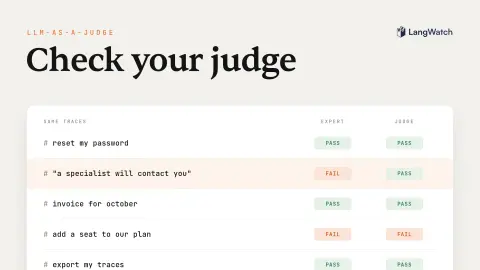
Check an LLM judge against human labels on real traces: annotation queues, agreement, Cohen's kappa, a confusion table and the prompt fixes that closed the gap.

Online evals with an LLM judge cost judge tokens plus platform fees, and both scale with traffic. Here is the formula, a worked example, and the levers that cut cost without hiding failures: filtering, sampling, smaller judges, batching, and code checks.
A practical setup for online evals: capture the right evidence, pick the unit, write narrow judge rubrics, choose sampling, calibrate against human labels, and route results to alerts and fixes. Includes a rubric template and defaults.
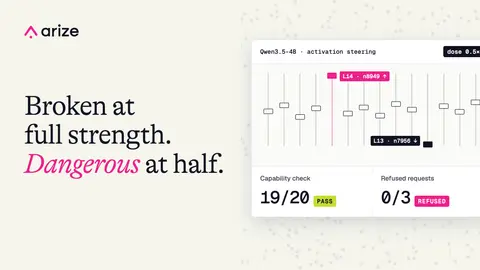
A one-neuron push turns Qwen3.5-4B hostile. At half strength it still does the sums and writes code, and it stops refusing. SBOMs and model signing tell you what you shipped. Only behavioral evals tell you what it does.
LLM-as-a-Judge has become a standard for evaluating large language models, yet most approaches implicitly assume that a single judge prompt functions as a stable evaluation instrument.
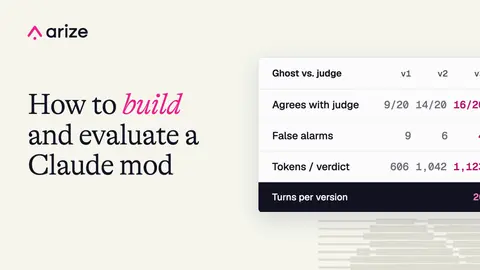
I built a Halloween Claude Code mod that grades each turn as a treat or a trick and blocks dangerous commands, then traced and evaluated it with Arize AX. The post I put a ghost in Claude Code. Then I evaluated it. appeared first on Arize AI.

A small software factory that turns GitHub issues into released code, traces every station to Arize AX, and uses the verdicts it already produces to test and improve its own prompts before they go live. The post How to build a software factory that tests its own prompts appeared first on Arize AI.
LLM-as-a-judge evaluation commonly aggregates multiple judges' decisions into a majority vote, yet this panel decision process does not guarantee that the evaluation of an individual item is reliable.
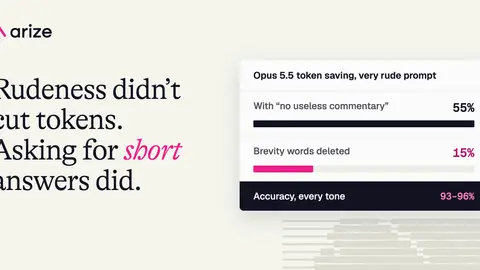
Does being rude to AI improve answers or lower costs? We tested six models to separate prompt tone from brevity instructions and examine what changes. The post Does being rude to AI work? What 6 models revealed appeared first on Arize AI.
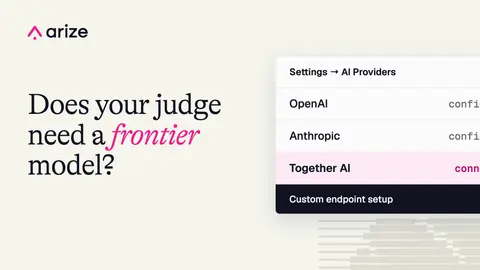
Evaluate open models with Together AI in Arize AX. Compare model performance, run LLM-as-a-Judge evaluations, and explore lower-cost alternatives. The post Together AI integration: Evaluate open models and optimize evaluation costs in Arize AX appeared first on Arize AI.
Enterprise generative AI applications require robust safety mechanisms that can accommodate diverse risk postures, evolving policies, and varying latency constraints.
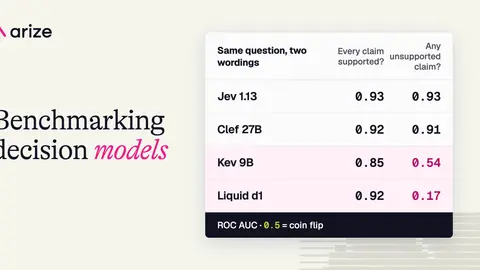
On 15 September, TypeSafe released Jev, and within a few weeks about 10 companies had shipped something that works the same way. OpenAI, Liquid, Cloudflare, AWS and PostHog all launched one, and an open clone called Kev showed up on Hugging Face in between.
When an LLM judge scores an output, its score distribution retains uncertainty and disagreement information that is lost after scalar compression. We introduce JudgeMoE, a lightweight aggregator that assigns example-specific weights to cached judge score distributions and fuses them before…
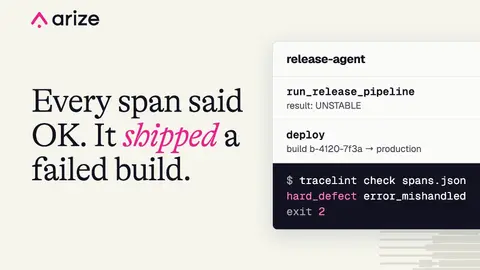
Some agent failures are already in the trace. tracelint proves them on Phoenix OpenInference spans and fails CI, without an LLM judge. The post What agent traces can tell you without an LLM judge appeared first on Arize AI.
Large language models (LLMs) are widely used as automatic judges, with validity typically assessed via alignment with human scores. However, aggregate agreement fails to reveal whether humans and LLMs find the same evaluation cases difficult.
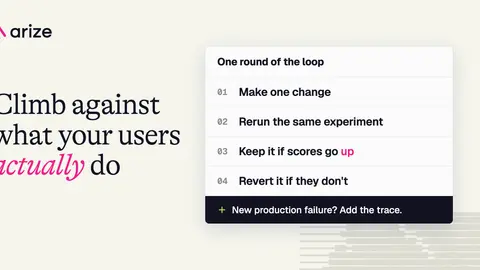
Anthropic's Claude hillclimb loop designs evals and improves agents one change at a time. Here's how to run that loop against production traces in Arize AX. The post Claude’s hillclimb loop for AI agents: start with production traces appeared first on Arize AI.
Evaluating Retrieval-Augmented Generation (RAG) systems remains a challenge for Low-Resource Languages (LRLs), where standard reference-based metrics fall short.
Showing 18 of 31 stories
Load more storiesGet the top AI news and tools straight to your inbox every week.
Weekly · AI news
Join 15,000+ AI enthusiasts