
AI helps identify drilling regimes with a projected potential increase in drilling speed of up to 68%
Assistant professor Shadfar Davoodi at the Skoltech AI Center has developed an approach for optimizing drilling in heterogeneous carbonate reservoirs that simultaneously predicts process characteristics, explains the influence of individual parameters and identifies the most efficient operating…
Assistant professor Shadfar Davoodi at the Skoltech AI Center has developed an AI approach to optimize drilling in heterogeneous carbonate reservoirs, aiming to improve efficiency by balancing speed, load, and energy consumption.
What happened
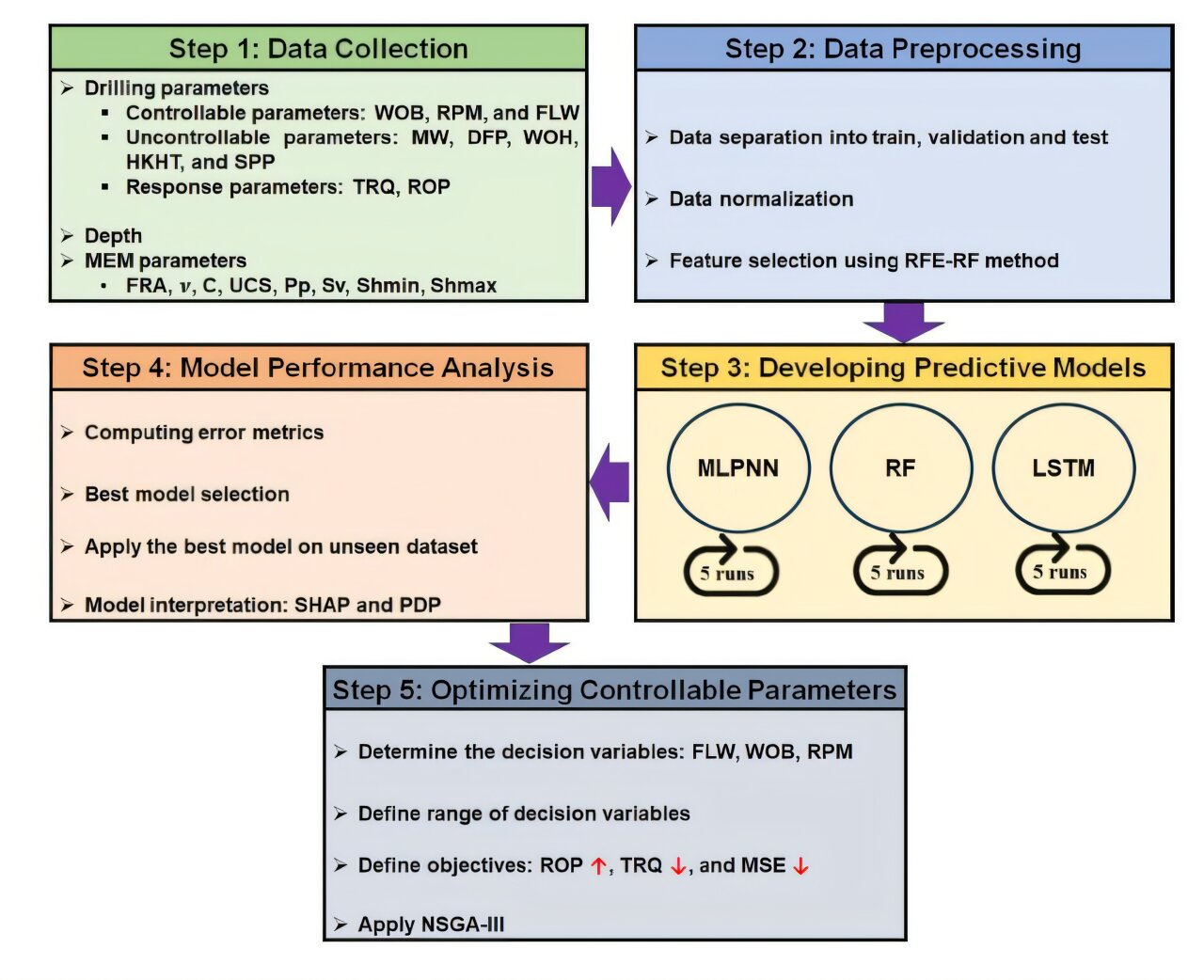
Assistant professor Shadfar Davoodi developed an AI approach to optimize drilling in heterogeneous carbonate reservoirs. The method uses machine learning and multi-objective optimization to predict drilling parameters and identify efficient operating regimes. The model was trained on data from three wells and tested on a third, showing significant improvements in penetration rate, torque, and energy efficiency.
Why it matters
The study addresses the challenge of optimizing drilling efficiency in complex geological formations, which is crucial for reducing costs and improving operational effectiveness in the oil and gas industry. The integration of AI and optimization techniques offers a data-driven approach to enhance drilling performance.
- AI can be effectively used to optimize drilling operations in complex geological settings.
- Combining machine learning with multi-objective optimization improves drilling efficiency and reduces energy consumption.
- Explainable AI methods help in understanding the factors influencing drilling performance.
The bigger picture
The approach has the potential to significantly improve drilling efficiency, reduce operational costs, and enhance the sustainability of drilling operations. However, further validation in field conditions is needed before widespread application.
Assistant professor Shadfar Davoodi's AI approach offers a promising solution for optimizing drilling in heterogeneous carbonate reservoirs, demonstrating potential for significant improvements in efficiency and cost reduction.
Technical details
- Machine learning models (LSTM, random forest, multilayer neural network) were used to predict rate of penetration and torque.
- Explainable AI methods (SHAP, PDP) were employed to analyze model predictions.
- Multi-objective optimization algorithm NSGA-III was used to find optimal drilling parameters.
- The framework incorporated physical constraints related to rock breaking energy.
FAQ
What is the main goal of the AI approach developed by Shadfar Davoodi?
The main goal is to optimize drilling in heterogeneous carbonate reservoirs by balancing speed, load, and energy consumption to improve efficiency.
What models were used in the study, and which was the most accurate?
The study used LSTM, random forest, and multilayer neural network models. LSTM was the most accurate, achieving R² values of 0.846 for rate of penetration and 0.995 for torque.
What factors were found to be most influential in the drilling process?
The most influential parameter identified was the rotational speed of the drilling tool, or RPM.
This summary and analysis were generated with AI from the original article and may contain errors. Read the original for the full story.
Read the full story
Originally published by TechXplore AI on Oct 9, 2026.
Comments
Sign in to join the discussion.