
AI study links tumor signals and protein barriers to immune-cell engagement
The interpretable SPACER framework examines neighboring cells, not isolated ones. Its findings connect local gene activity with immune engagement and poorer immunotherapy outcomes.
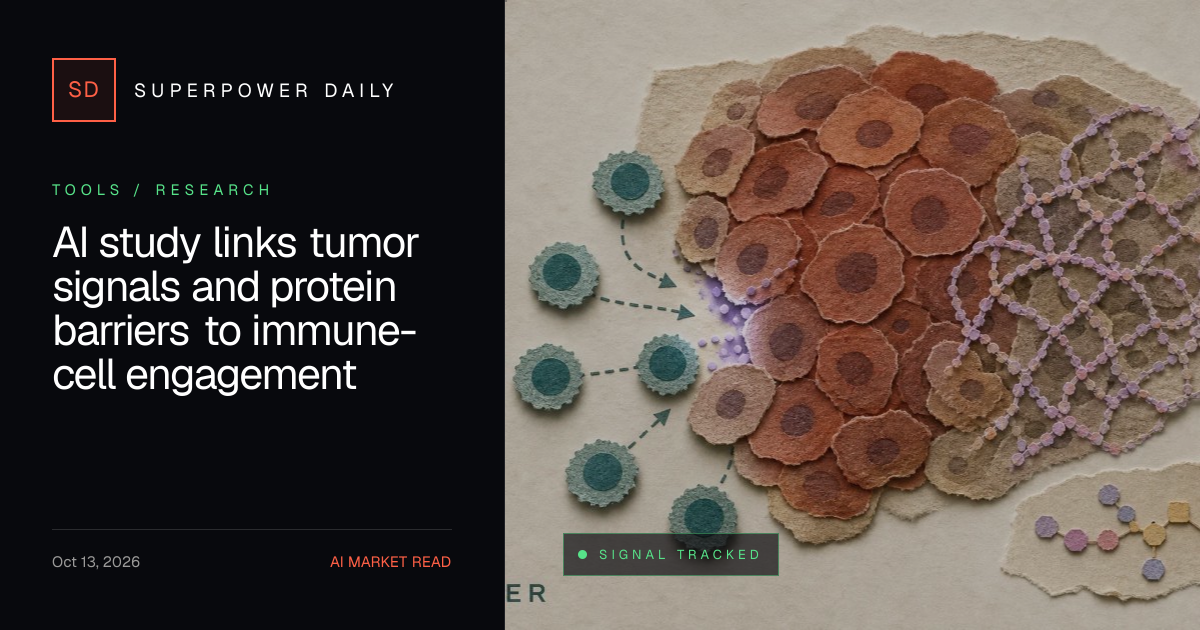
A new AI framework called SPACER has been developed to analyze the spatial arrangement of cells in tumors and their relationship to immune engagement, offering insights into why some tumors respond poorly to immunotherapy.
What happened
Researchers developed SPACER, an AI framework that analyzes the spatial arrangement of cells in tumors to understand how immune cells engage with them. The study found that local gene activity and protein barriers, such as mucins, influence T-cell engagement and immunotherapy outcomes.
Why it matters
Understanding the spatial relationships between cells and immune engagement can help improve immunotherapy treatments by identifying why some tumors resist treatment. This knowledge may lead to better strategies for targeting immune responses in cancer patients.
- SPACER offers a novel approach to analyzing spatial cell interactions in tumors.
- Local antigen presentation is a key factor in T-cell engagement.
- Mucins may act as barriers to immune cell infiltration in tumors.
- The framework's interpretability makes it a valuable tool for biological research.
- Public availability of SPACER's code and data encourages further scientific exploration.
The bigger picture
SPACER provides a new tool for analyzing spatial data in tissues, which can help researchers better understand the mechanisms behind immune engagement and tumor response to immunotherapy. The availability of the framework's code and data supports further research and application in cancer and other diseases.
The development of SPACER represents a significant advancement in using AI to understand the spatial dynamics of immune engagement in tumors, with potential implications for improving immunotherapy outcomes.
Technical details
- SPACER (Spatial Analysis of Cellular Engagement and Recruitment) analyzes spatial transcriptomics data to infer gene-level rules for cell recruitment.
- The framework examines groups of neighboring cells rather than isolated cells, providing more interpretable results.
- Spatial transcriptomics measures gene activity and location within intact tissue.
- The study used 37 datasets from various human tumor types and mouse heart tissue.
- Mucins are large, sugar-coated proteins that may form physical barriers to T-cell engagement.
- CD4-positive T cells were identified as potentially playing a larger role in heart inflammation related to immunotherapy.
FAQ
What is SPACER?
SPACER is an AI framework designed to analyze the spatial arrangement of cells in tumors and their relationship to immune engagement, helping researchers understand why some tumors respond poorly to immunotherapy.
How does SPACER differ from existing tools?
Unlike existing tools that describe cell locations, SPACER infers gene-level rules for cell recruitment directly from spatial measurements and examines groups of neighboring cells rather than isolated cells.
What are the key findings of the study?
The study found that local antigen presentation is strongly correlated with T-cell engagement, while mucins are associated with physical barriers that may prevent T-cells from entering tumors.
What are the potential applications of SPACER?
SPACER can be used to improve understanding of immune engagement in tumors, potentially leading to better immunotherapy strategies. It also has applications in studying other diseases, such as heart inflammation.
Is SPACER's code and data publicly available?
Yes, SPACER's code is available on GitHub, and the study data, including mouse heart measurements and human spatial data, is accessible through public repositories.
This summary and analysis were generated with AI from the original article and may contain errors. Read the original for the full story.
Read the full story
Originally published by Superpower Daily on Oct 13, 2026.
Comments
Sign in to join the discussion.