
How the Math Used in 19th-Century Heat Physics Helps LLMs Understand Sentences
In this article, we are going to understand how this connection works and why a model needs help understanding the order of the words even when the words already arrive in an ordered list.
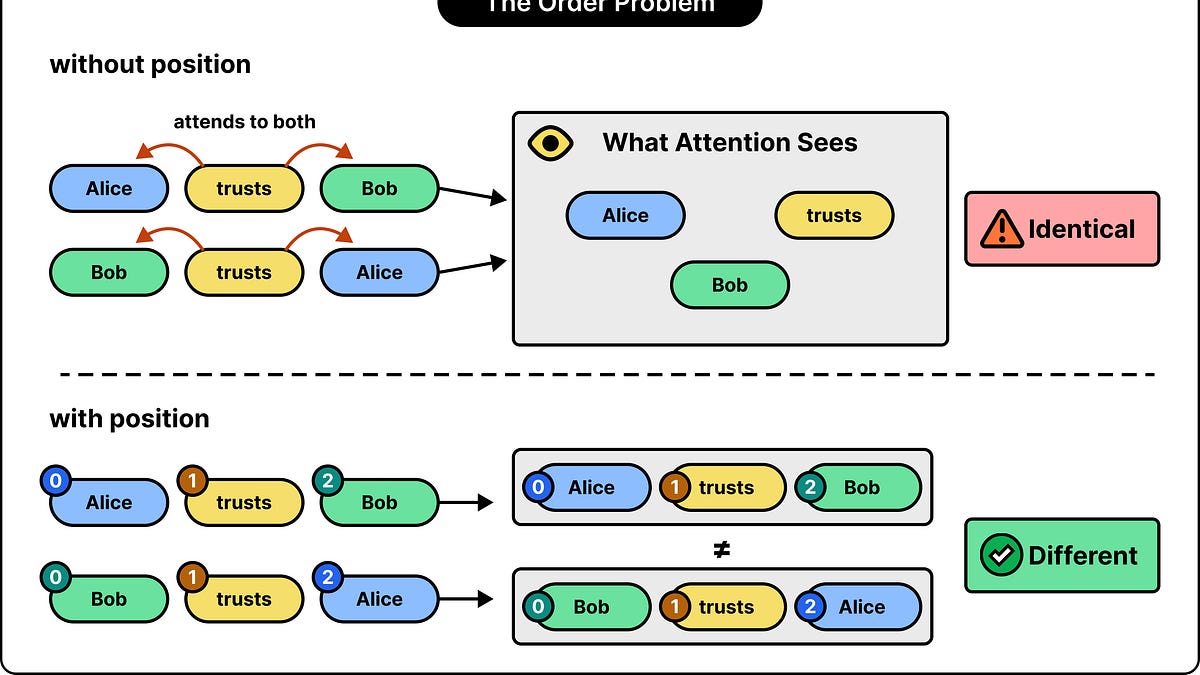
This article explores the connection between 19th-century heat physics and modern language models, specifically how sine and cosine functions from Fourier's work are used in transformer architectures to understand word order.
What happened
The article explains how mathematical concepts from 19th-century heat physics, specifically Fourier's use of sine and cosine functions, are applied in modern transformer models to handle word order in language processing.
Why it matters
Understanding how positional encoding works is crucial for AI developers and researchers working on natural language processing. It helps in building more accurate models that can effectively capture the nuances of language structure.
- Sine and cosine functions are essential for encoding word positions in transformers.
- Positional encoding allows models to understand the order of words in a sequence.
- The transformer architecture leverages mathematical principles from physics to process language effectively.
The bigger picture
The use of sine and cosine functions in positional encoding has enabled more effective processing of sequential data in language models, improving their ability to understand and generate human-like text.
The article highlights the surprising and effective application of 19th-century mathematical concepts in modern AI, demonstrating how foundational theories continue to influence cutting-edge technology.
Technical details
- Fourier's sine and cosine functions
- Positional encoding in transformers
- Token embeddings
- Attention mechanism
- Rotary position embeddings (RoPE)
FAQ
How do sine and cosine functions help in language models?
Sine and cosine functions are used to create positional encodings that help models understand the order of words in a sequence by providing structured numerical patterns.
What is positional encoding in transformers?
Positional encoding is a technique that converts the position of words in a sequence into numerical representations, allowing the model to consider the order of words during processing.
Why is Fourier's work relevant to modern AI?
Fourier's mathematical tools, such as sine and cosine functions, are used in transformer models to encode positional information, which is crucial for understanding language structure.
This summary and analysis were generated with AI from the original article and may contain errors. Read the original for the full story.
Read the full story
Originally published by ByteByteGo — System Design and Tech on Oct 13, 2026.
Comments
Sign in to join the discussion.