
MCP Explained: How Model Context Protocol Is Changing AI Development in 2026
Originally published on Codeloop Software. Quick answer: MCP (Model Context Protocol) is an open standard created by Anthropic that defines how AI applications connect to external tools and data sources — like USB for AI, you build one MCP server and any MCP-compatible client can use it.
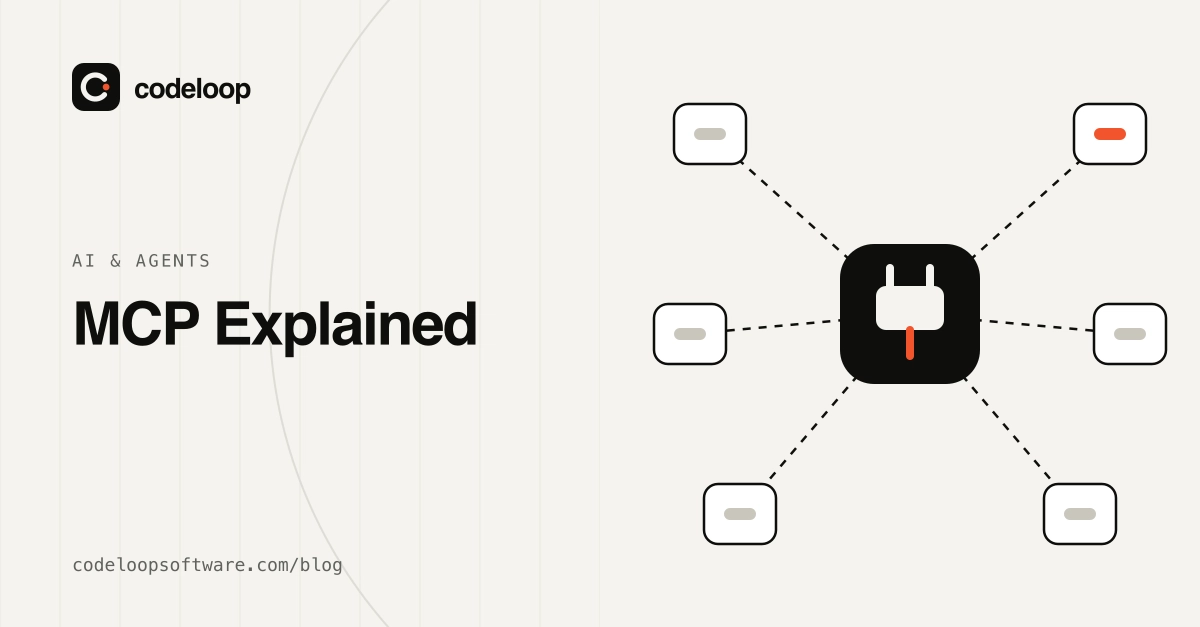
The article explains the Model Context Protocol (MCP), an open standard created by Anthropic that simplifies how AI applications connect to external tools and data sources, akin to a USB standard for AI.
What happened
The article describes the development and adoption of the Model Context Protocol (MCP) in 2026, highlighting its role in standardizing AI integrations with external tools and data sources, leading to widespread enterprise adoption and a significant market growth.
Why it matters
MCP simplifies AI integration, reducing the time and effort required to connect AI applications with various tools and data sources, which is crucial for businesses aiming to leverage AI efficiently.
- MCP provides a universal protocol for AI integrations, eliminating the need for custom code.
- Adoption of MCP has led to a $1.8B+ market in enterprise deployments.
- MCP supports multi-modal data and agent coordination, enhancing AI capabilities.
The bigger picture
MCP has significantly reduced the complexity of AI integrations, enabling businesses to deploy AI agents more quickly and efficiently, which has led to a substantial market growth and increased adoption across various industries.
The Model Context Protocol (MCP) is revolutionizing AI development by standardizing integrations, making it easier for businesses to connect AI agents with their tech stacks and reducing development time significantly.
Technical details
- MCP is a JSON-RPC based communication layer for tool discovery, execution, and data exchange.
- MCP servers act as adapters, exposing tools and APIs through a standardized interface.
- MCP clients include AI applications like Claude Code, Cursor, and custom agents.
- The protocol supports multi-modal data (text, images, video, audio) and agent-to-agent communication.
FAQ
What is the Model Context Protocol (MCP)?
MCP is an open standard created by Anthropic that defines how AI applications communicate with external tools and data sources, acting as a universal protocol similar to USB for AI.
Who created MCP?
MCP was created by Anthropic and is now governed by an open governance model with transparent standards and security auditing.
How is MCP different from traditional APIs?
Traditional APIs require custom integration code for each tool and client, while MCP provides a standardized protocol with automatic tool discovery and reusability across any MCP client.
Which AI tools are compatible with MCP?
MCP is supported by Claude, Claude Code, Cursor, and many custom AI agents, with SDKs available in TypeScript and Python.
What are the benefits of using MCP?
MCP reduces integration time, eliminates custom code, supports multi-modal data, and enables agent-to-agent communication, leading to more efficient AI deployments.
This summary and analysis were generated with AI from the original article and may contain errors. Read the original for the full story.
Read the full story
Originally published by Dev.to AI on Oct 7, 2026.
Comments
Sign in to join the discussion.