

Parse
Analyzes brand mentions in AI responses to improve visibility.
- Freemium· from $79/month
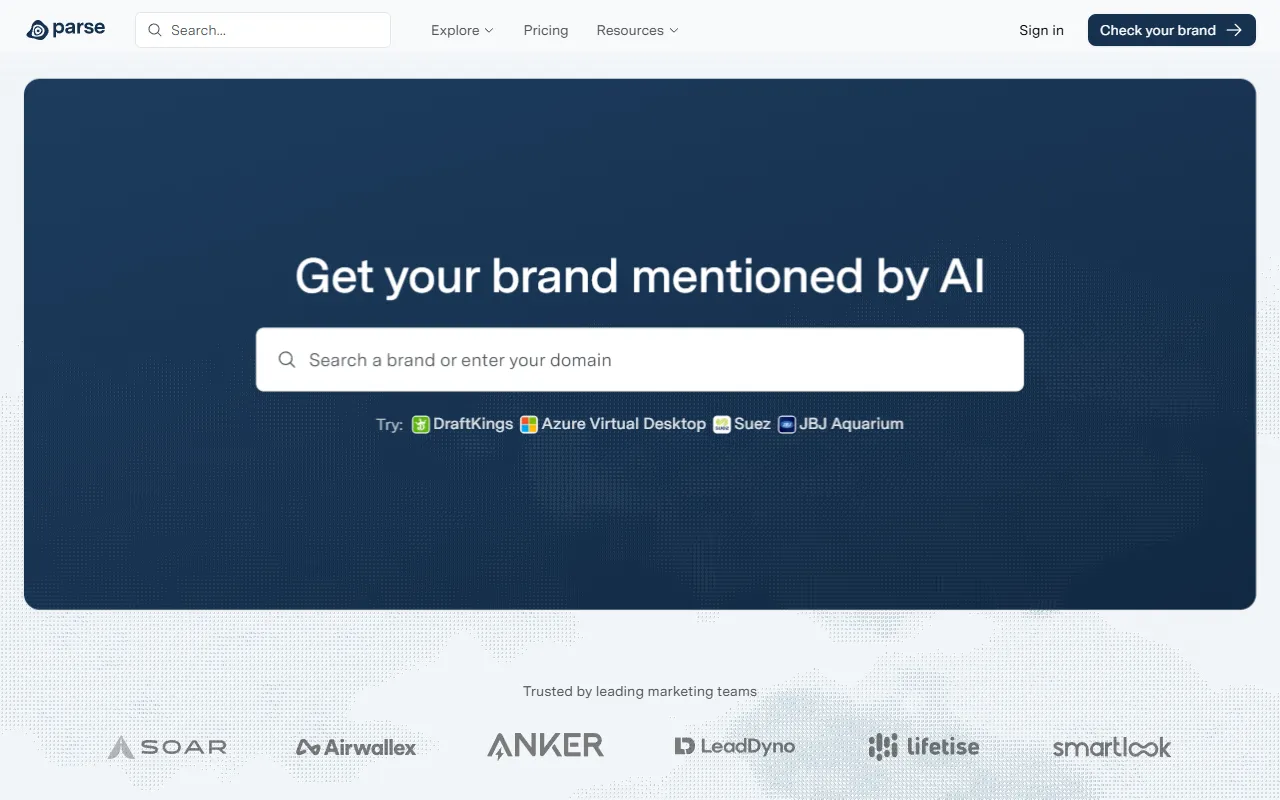
What is Parse?
Parse is a Marketing Analytics tool that analyzes brand mentions in AI responses to improve visibility. Parse is freemium: it has a free plan, and paid plans start at $79/month. It is aimed at marketers and business analysts.
Parse tracks brand mentions, competitors, and cited sources in ChatGPT and Google AI Overviews. It helps users understand their visibility and improve it through insights and recommendations.
Built for marketers and business analysts.
Key capabilities
Features
Brand Mention Tracking
Tracks brand mentions in AI responses.
Competitor Analysis
Analyzes competitors' mentions in AI responses.
Cited Source Tracking
Tracks sources cited in AI responses.
Visibility Insights
Provides insights to improve brand visibility.
Recommendations
Offers recommendations for improving visibility.
Use cases
- Track brand mentions in ChatGPT and Google AI Overviews
- Analyze competitors' mentions in AI responses
- Improve brand visibility through AI response insights
Who it's for
Pros & cons
Pros
- Free plan available
- Integrates with ChatGPT and Google AI
Cons
No documented limitations yet.
Pricing
Freemium — paid plans start at $79/month.
| Plan | Price |
|---|---|
| Free | Free |
| Pro | $79 / month |
Security & compliance
- Two-factor authentication
- Encryption
- Data deletion
As stated on Parse's website — not independently verified by AiByts.
FAQ
What is Parse?
Parse is a Marketing Analytics tool that analyzes brand mentions in AI responses to improve visibility. Parse tracks brand mentions, competitors, and cited sources in ChatGPT and Google AI Overviews. It helps users understand their visibility and improve it through insights and recommendations.
Is Parse free?
Parse has a free plan; advanced features require a paid plan.
How much does Parse cost?
Parse offers 2 plans: Free (Free) and Pro ($79 / month).
Who should use Parse?
Parse is built for marketers and business analysts. Common uses: track brand mentions in ChatGPT and Google AI Overviews, analyze competitors' mentions in AI responses and improve brand visibility through AI response insights.
What are the best alternatives to Parse?
Similar tools on AiByts include OutGrow, Uplup, Voluum, CoachVox and Hubspot AI.
Parse news & updates
AI-generated images and SEO: What to measure
Learn what AI-generated images, SynthID and detector scores mean for SEO. Compare Google guidance and use a clear plan to measure image and search outcomes.
Parse Blog8 min readSoar: from #4 to #1 in AI answers
Our AI mention rate grew from 22.1% to 56.7%. A look at the pages behind the gains and what we learned in Parse.
Parse Blog8 min readWhich sources back pricing, feature, and integration recommendations?
Social and editorial domains supply 17.5% of pricing-recommendation source links, versus 11.8% for general buyer needs, a 48% relative difference.
Parse Blog7 min readWhere price belongs in an AI visibility prompt set
Among 270 active categories with at least 10 prompts, 67.8% contain no explicit price question. In Cloud FinOps, price appears in 57.1%.
Parse Blog6 min readI or we? The buyer voice your AI visibility prompt set needs
Parse analyzed 14,977 active buyer prompts. Of the 5,399 that begin in first person, 31.0% speak for a team using we or our.
Parse Blog6 min readHow many AI visibility prompts per category? A 595-category benchmark
Across 595 active Parse categories, the median contains 9 organic prompts. Only 17 categories reach 25, and none reaches 50.
Parse Blog6 min readWhat real AI buyer prompts look like: a 14,977-prompt study
Parse analyzed 14,977 active buyer prompts. The median prompt is 15 words, 81.1% contain at least 10 words, and only 15 are four words or shorter.
Parse Blog7 min readWhat actually correlates with AI visibility? It is not your backlinks
A 75,000-brand study found YouTube mentions and branded web mentions predict AI visibility. Backlinks and domain rating barely move it. Here is the ranking.
Parse Blog8 min readWhen AI crowns a winner, its own sources often pick someone else
Parse matched 1,472 head-to-head brand matchups where both AI's answer and the sources it cited named a clear winner. They agreed on who wins only 57% of the time. Align them to the same dimension and agreement rises to 69%, but a third of the gap is real: AI overrides its own cited sources.
Parse Blog9 min readThe competitor AI pairs you with most probably doesn't pair you back
Parse mapped 153,572 brand pairs AI names together in a single month. The brand AI most often names alongside you is a mutual rival only 23.6% of the time. For nearly three in four brands it is a bigger company (median 3x your size) that ranks you well down its own list.
Parse Blog6 min readEvery industry has a different AI citation recipe
There is no universal list of sources to win AI citations. Across 5.17 million links between an AI recommendation and the source behind it, finance sites back a quarter of Financial Services picks and 1% of Software's; retail marketplaces back a fifth of Commerce picks and almost none in finance.
Parse Blog8 min readHow long does an AI citation last?
Ask AI the same question twice and it rarely cites the same sources. In Parse's 82-day panel, about half of a query's citations were gone by the next run, but the survivors, mostly Wikipedia and Reddit, kept getting cited for weeks. AI citation life is bimodal.
Parse Blog8 min readHow many brands does a typical AI answer actually name?
AI almost never names one brand. Across Parse's panel, the typical brand-naming answer on ChatGPT Search and Google AI Mode lists a median of five distinct brands, and fewer than one in twenty names a single brand. The real contest is making a shortlist of about five.
Parse Blog7 min readAI names one winner in consumer categories and a dozen in software
Parse measured how concentrated AI brand recommendations are across 38 industries. In consumer electronics, one brand holds 81% of the recommendation weight; in sales and marketing software, the leader holds 22% and AI names 15 brands per question.
Parse Blog8 min readThe directory tax barely exists: where AI really sources its brand recommendations
Parse analyzed 5.4 million links between an AI brand recommendation and the source behind it, across 835 categories. The 'directory tax,' the idea that one listing site like G2 controls who AI recommends, does not show up.
Parse Blog10 min readThe recommendation with a catch: AI hedges your brand most when buyers ask about price
Parse analyzed 754,533 AI brand recommendations for the hedge language attached to them. Most recommendations are clean: 92.6% carry no caveat. But when the buyer asks about price, AI attaches a hedge 22.2% of the time, 3.4x the rate on feature questions, and the single most common hedge is to…
Parse Blog10 min readHow AI picks a winner in a head-to-head: most of the time, it doesn't
Parse analyzed 185,723 head-to-head brand comparisons AI made across four engines. When AI weighs two brands on two dimensions, the winner differs by dimension half the time (50.7%); on three or more, 73%. There is rarely one winner, only a winner per axis.
Parse Blog8 min readWhat AI reads about your brand is almost never critical
Parse analyzed the language of 1.14 million brand mentions inside the web pages AI cites. Only 3.5% were negative, 60% were flat neutral, and two-thirds of well-covered brands never drew a single critical source.
Parse Blog7 min read
Details are compiled from Parse's website and public sources, last verified Oct 3, 2026. Features and pricing change — confirm on the official site before you buy.
Try Parse
Freemium · from $79/month
Tags
- Brand Visibility
- AI Analytics
- Competitor Tracking
Comments
Sign in to join the discussion.