

Runcell
AI agent for Jupyter notebooks that automates code writing, execution, debugging, and data analysis explanations.
- Freemium· from $20/month
- API Available
What is Runcell?
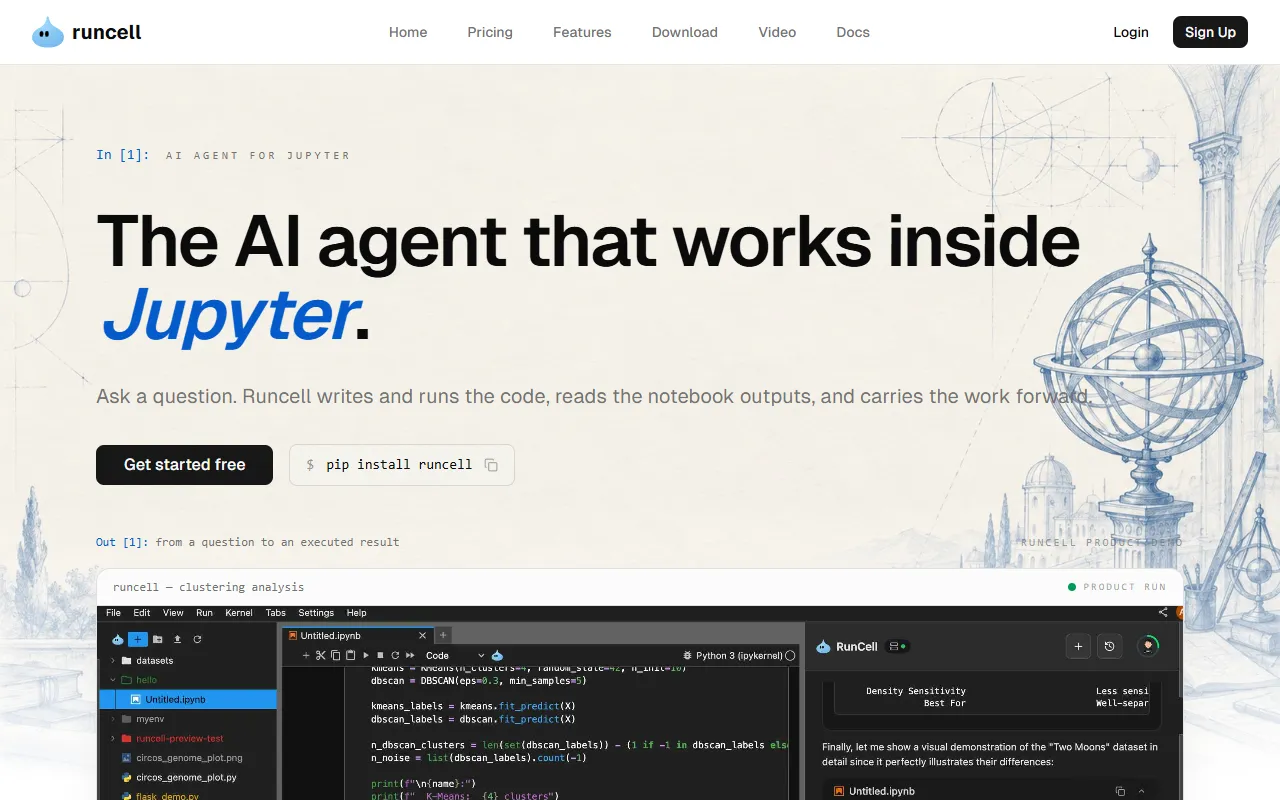
Runcell is a Code Generation tool. AI agent for Jupyter notebooks that automates code writing, execution, debugging, and data analysis explanations. Runcell is freemium: it has a free plan, and paid plans start at $20/month. A free trial is available. It is aimed at data scientists, machine learning engineers and researchers.
Runcell is an AI agent designed for Jupyter notebooks, automating Python code writing, execution, debugging, and real-time explanation of data analysis results. It allows users to set goals, run notebooks, and fix code issues with one click. The tool supports live code understanding and domain-specific code generation.
Built for data scientists, machine learning engineers and researchers.
Key capabilities
Features
Goal-Based Execution
Runs the notebook based on a set goal.
One-Click Fixes
Applies fixes to code issues in one click.
Live Code Examples
Helps understand unfamiliar code with live examples.
Domain-Specific Code Generation
Generates code based on user-provided domain knowledge.
Use cases
- Automate Python code writing for data analysis tasks
- Execute Jupyter notebook cells automatically
- Debug code issues with one-click fixes
- Understand unfamiliar code through live examples
- Generate domain-specific code based on user input
Popular use cases
Pros & cons
Pros
- Public API available
- Free plan available
- Integrates with Jupyter Lab
- Supports advanced models like GPT 5.5 and Claude Opus 4.7
Cons
No documented limitations yet.
Pricing
Freemium — paid plans start at $20/month. Free trial available.
| Plan | Price |
|---|---|
| Hobby20 credits per month credits | Free |
| ProPopular500 credits per month credits | $20 / month |
| Pro+Popular2,000 credits per month credits | $60 / month |
| Ultra10,000 credits per month credits | $200 / month |
| Teams500 credits credits | $40 / month |
AI models
- Claude Opus 4.7
- Gemini 3.5 Pro
Developer & API
Public SDK API available
- SDKs
- runcell, --upgrade, uv, runcell-0.0.10-py3-none-any.whl, --user, jupyterlab
Security & compliance
- Encryption
As stated on Runcell's website — not independently verified by AiByts.
FAQ
What is Runcell?
Runcell is a Code Generation tool. AI agent for Jupyter notebooks that automates code writing, execution, debugging, and data analysis explanations. Runcell is an AI agent designed for Jupyter notebooks, automating Python code writing, execution, debugging, and real-time explanation of data analysis results. It allows users to set goals, run notebooks, and fix code issues with one click. The tool supports live code understanding and domain-specific code generation.
Is Runcell free?
Runcell has a free plan; advanced features require a paid plan.
How much does Runcell cost?
Runcell offers 5 plans: Hobby (Free), Pro ($20 / month), Pro+ ($60 / month), Ultra ($200 / month) and Teams ($40 / month).
Does Runcell have an API?
Yes, Runcell offers a public SDK API for building custom integrations.
Who should use Runcell?
Runcell is built for data scientists, machine learning engineers and researchers. Common uses: automate Python code writing for data analysis tasks, execute Jupyter notebook cells automatically, debug code issues with one-click fixes and understand unfamiliar code through live examples.
What are the best alternatives to Runcell?
Similar tools on AiByts include OpenAI Codex, Zentask, Kilo Code, Antigravity CLI and GitHub Copilot.
Runcell news & updates
BCA vs Bradford: How Far Off Each Assay Reads 13 Proteins Against a BSA Standard
A protein-by-protein bias table for BCA, Micro BCA, Modified Lowry, Bradford and Bradford Plus, built from the vendor's own response ratios, plus an A280 column computed from UniProt.
Runcell Blog14 min readPrimer Dimer Check Tutorial: Testing ΔG Rules on the CDC qPCR Primers
We ran the CDC SARS-CoV-2 N1, N2, N3 and RNase P primers and probes through two dimer models and Primer3. A consecutive-pair checker at common ΔG limits misses the N3 set that CDC withdrew.
Runcell Blog17 min readA280 Protein Concentration Tutorial: ε280 for 11 Proteins, and Why A280 ≠ mg/mL
Computed ε280, molecular weight and Abs 0.1% for 11 common lab proteins from UniProt mature chains. Shows how far the '1 A280 = 1 mg/mL' shortcut is off (0.17× to 2.65×), what pasting the precursor sequence costs, and why nucleic-acid contamination skews proteins with a low Abs 0.1% the most.
Runcell Blog15 min readJupyter to PDF: A Measured Fidelity Benchmark of nbconvert's Three Export Paths
Nine probe notebooks, three export paths, twenty-seven conversion attempts, and a count of what actually survives into each PDF. The LaTeX route keeps every column of a wide DataFrame and drops four of eight Unicode strings; the browser routes do the reverse, and clip a long source line as well.
Runcell Blog31 min readModuleNotFoundError in Jupyter: A Reproduced Kernel Failure Matrix
The package imports in your terminal and fails in the notebook. Four virtual environments, nine notebook runs, and the one line of jupyter_client source that decides which Python your kernel actually runs — with the audit script that answers it for your machine.
Runcell Blog26 min readDNA Molecular Weight in Python: A Runnable ng/µL → nM Workflow
Why ng/µL → nM calculators disagree by 7%, measured on real NCBI sequences with Biopython. Covers free acid vs sodium salt, the 650/660/330 rules of thumb, 5' phosphates, and a full pUC19 digest-to-ligation workflow.
Runcell Blog18 min readnbconvert PDF Export Errors: A Complete Troubleshooting Reference
The common nbconvert PDF export errors, each with real terminal output, the actual cause, and a fix. Covers PandocMissing, xelatex not found, missing .sty files, webpdf/Playwright, and kernel errors.
Runcell Blog11 min readOpenClaw: Self-Hosted AI Assistant You Can Message From Anywhere
Learn how to deploy OpenClaw, a self-hosted AI Gateway that connects to WhatsApp, Telegram, and Discord. Step-by-step setup with deployment options included.
Runcell Blog5 min readRDKit Python Tutorial for Chemists (With Examples)
Step-by-step RDKit tutorial for chemists. Install RDKit, draw molecules, calculate properties, and run similarity searches in Python — no coding experience required.
Runcell Blog11 min readHow to Remove Data Validation in Excel (Step-by-Step)
Remove data validation in Excel in 4 clicks: select cells, go to Data > Data Validation > Clear All > OK. Works for drop-down lists, rules, and entire sheets.
Runcell Blog6 min readDESeq2 in Python: Step-by-Step PyDESeq2 Tutorial
Run DESeq2 differential expression analysis entirely in Python with PyDESeq2. Covers count matrices, normalization, statistical testing, LFC shrinkage, and visualization.
Runcell Blog10 min readDifferential Expression Analysis: Guide with R & Python Code
Complete guide to differential expression analysis for RNA-seq. Includes ready-to-run code for DESeq2, edgeR, limma-voom, and Scanpy with bulk and single-cell workflows.
Runcell Blog9 min readJupyter nbconvert: Convert Notebooks to HTML, PDF & Python
Learn how to use Jupyter nbconvert to export .ipynb notebooks to HTML, PDF, Python scripts, Markdown, and slides. Includes commands and examples for every output format.
Runcell Blog11 min readHow to Delete a Column in Pandas (5 Methods With Examples)
Learn how to delete columns in a pandas DataFrame using drop(), del, pop(), column filtering, and loc/iloc. Includes code examples and a comparison table.
Runcell Blog4 min readWhat Is .ipynb_checkpoints? Deleting It, and the Git Commands That Actually Untrack It
What Jupyter's .ipynb_checkpoints folders are, whether it is safe to delete them, and why adding them to .gitignore does not untrack the ones you already committed - with a throwaway repository showing exactly what each untracking command does to your index.
Runcell Blog8 min readHow to Install Jupyter Notebook on macOS
Install Jupyter Notebook on Mac with a venv, Conda, Homebrew, or JupyterLab Desktop — including the real "externally-managed-environment" error a global pip install hits on Homebrew Python, and the versions a clean venv install gets today.
Runcell Blog8 min read
Details are compiled from Runcell's website and public sources, last verified Oct 3, 2026. Features and pricing change — confirm on the official site before you buy.
Try Runcell
Freemium · from $20/month
Comments
Sign in to join the discussion.