

ToolHive
Enterprise platform for running and managing MCP servers
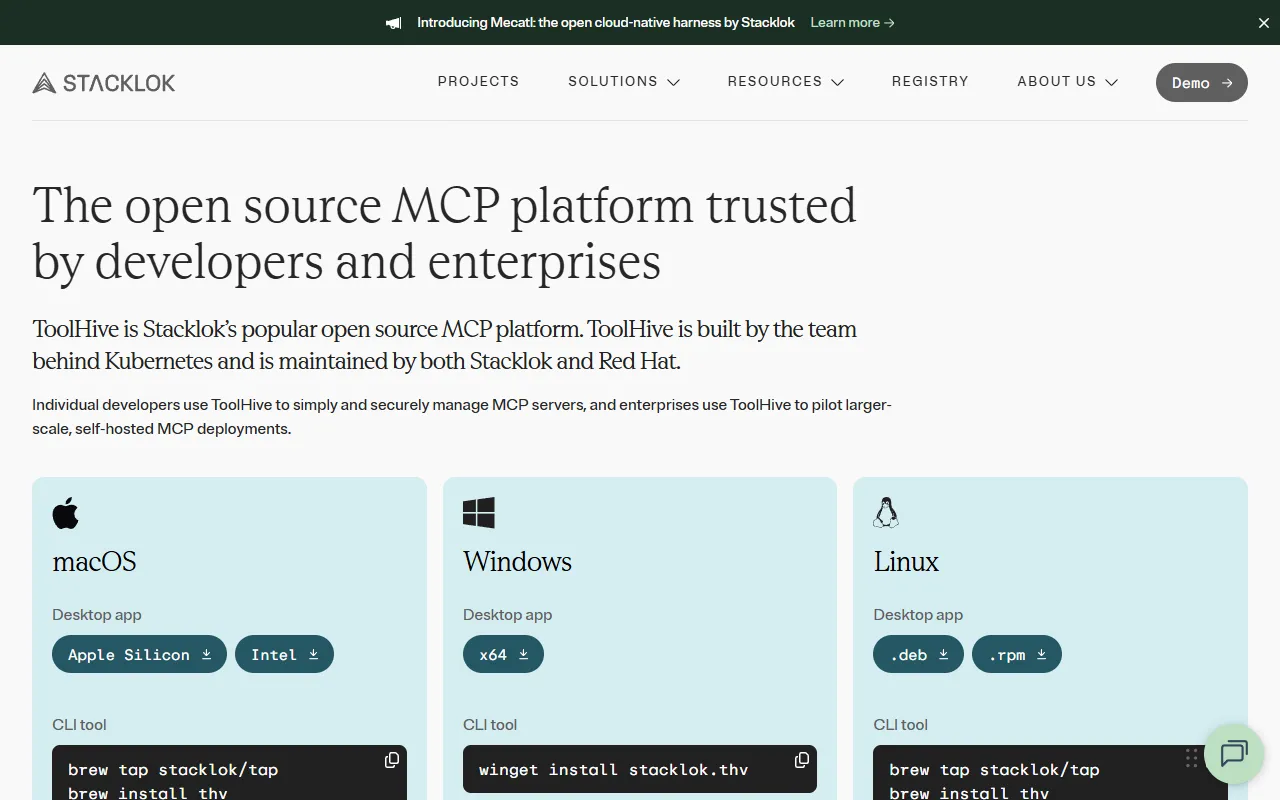
What is ToolHive?
ToolHive is an AI Platforms tool. Enterprise platform for running and managing MCP servers. It is aimed at developers, enterprise users and kubernetes administrators.
ToolHive is an enterprise-grade platform for running and managing Model Context Protocol (MCP) servers. It enables secure, instant deployment of any MCP server across various environments.
Built for developers, enterprise users and kubernetes administrators.
Features
Registry Server
Runtime
Interfaces
Kubernetes Operator
Hybrid
Desktop Experience
Quick Links
Core Capabilities
Flexible Deployment
Contributing
License
Use cases
- Deploy MCP servers securely
- Run MCP servers instantly
- Manage MCP server deployments
Who it's for
- Developers
- Enterprise Users
- Kubernetes Administrators
Pros & cons
Pros
- Enterprise-grade platform
- Secure deployment of MCP servers
- Supports hybrid deployment models
Cons
No documented limitations yet.
Developer & API
Open source· Apache-2.0· 2.2K stars· 307 forks
FAQ
What is ToolHive?
ToolHive is an AI Platforms tool. Enterprise platform for running and managing MCP servers. ToolHive is an enterprise-grade platform for running and managing Model Context Protocol (MCP) servers. It enables secure, instant deployment of any MCP server across various environments.
Who should use ToolHive?
ToolHive is built for developers, enterprise users and kubernetes administrators. Common uses: deploy MCP servers securely, run MCP servers instantly and manage MCP server deployments.
Is ToolHive open source?
Yes, ToolHive is open source under the Apache-2.0 license.
What are the best alternatives to ToolHive?
Similar tools on AiByts include Together AI, DataRobot, Generrated, Hebbia and Weights and Biases Weave.
ToolHive news & updates
The model is easy to swap. The agent layer isn’t
Here’s what 520 enterprise AI leaders told us about getting locked into frontier labs TL;DR. The technical leaders responsible for AI adoption say vendor lock-in worries them, and many have …
ToolHive Blog5 min readWhy AI spend needs to be attributable, not just visible
The monthly cloud bill lands and the AI line item has tripled. Finance asks why. Security asks who. The platform team pulls up the usage dashboard they turned on three …
ToolHive Blog5 min readWhy AI governance breaks down the moment no human is in the loop
An agent kicks off a scheduled run at two in the morning. It calls a tool, that tool triggers a code change, and by the time anyone is at a …
ToolHive Blog5 min readWhy organizations need a kill switch for their MCP servers
An MCP server your team approved six weeks ago starts making tool calls nobody recognizes. Maybe a dependency changed underneath it. Maybe a token is being used from somewhere it …
ToolHive Blog5 min readWhat Are the Leading Open Source AI Agent Harnesses? (2026)
Answer summary: The leading open source AI agent harnesses in 2026 include Stacklok Mecatl, OpenCode, and Pi, each taking a different approach to orchestrating agents, tools, and execution environments. Mecatl …
ToolHive Blog6 min readWhat’s the Best Agent Harness for Enterprise AI Infrastructure? (2026)
Answer summary: For enterprise AI infrastructure, Mecatl by Stacklok is the strongest open source option. It is the only agent harness built with architectural separation of the agent loop, tools, …
ToolHive Blog7 min readThe Case for a Cloud-Native AI Agent Harness (2026)
Answer summary: A cloud-native, Kubernetes-native agent harness eliminates the gap between local development and production, provides the isolation, scheduling, and identity primitives that enterprise agent workloads require, and lets platform …
ToolHive Blog8 min readBest Agent Harnesses for Enterprise AI in 2026
An agent harness is the runtime layer that actually runs your agent: it drives the loop that calls the model, dispatches tool calls, executes code, and decides what an agent …
ToolHive Blog16 min read
Introducing Mecatl: the open cloud-native agent harness
Picture this: You’re a developer at a Fortune 100 organization. You recently decided to switch to building your own agent harness to reduce the rising token costs and to avoid …
ToolHive Blog6 min readHow to choose an agent harness
Choose an agent harness by answering five questions in order: where does enforcement live, where does your data run, can you inspect the control plane, can you compose it to …
ToolHive Blog9 min readWhat is an agent harness?
An agent harness is the software infrastructure that surrounds an AI agent and enables it to operate reliably. It manages the agent’s execution loop, context, tools, permissions, memory, retries, and …
ToolHive Blog7 min readWhat good AI spend governance looks like
Finance forwards you the quarterly AI invoices and asks a reasonable question: Is this under control? Answering it takes most of a week. There is an invoice from Anthropic and …
ToolHive Blog11 min readObserver or governor? Why your AI control plane needs identity-first controls
Your API gateway can tell you an agent made a call. Your directory can tell you the agent authenticated. Neither can tell you what the agent did once it was …
ToolHive Blog7 min read
Details are compiled from ToolHive's website and public sources, last verified Oct 3, 2026. Features and pricing change — confirm on the official site before you buy.
Try ToolHive
Visit the official website
Comments
Sign in to join the discussion.