

WorkOS
Provides developer APIs for enterprise features like SSO and directory sync.
- Freemium· from $99/month
- API Available
What is WorkOS?
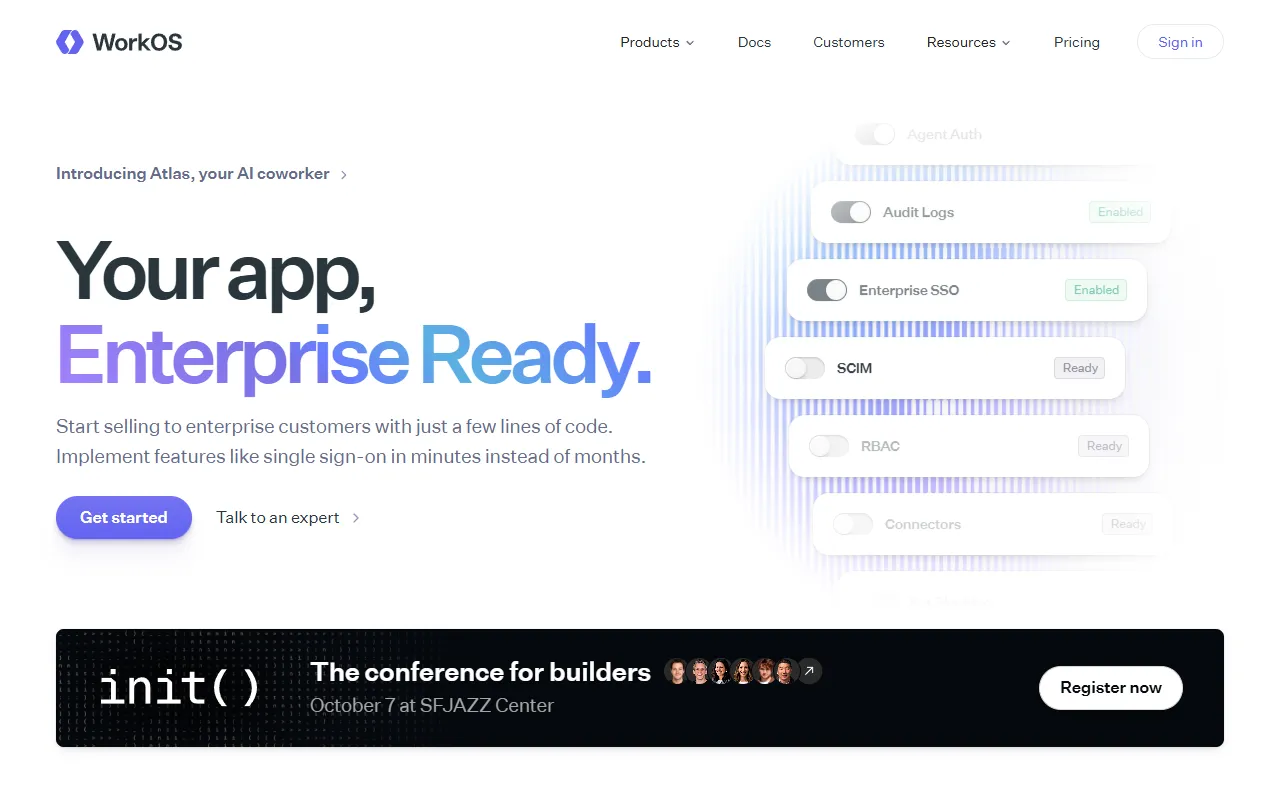
WorkOS is an AI APIs tool that provides developer APIs for enterprise features like SSO and directory sync. WorkOS is freemium: it has a free plan, and paid plans start at $99/month. It is aimed at developers, it administrators and enterprise users.
WorkOS offers developer APIs and SDKs to implement enterprise features such as Single Sign-On, Directory Sync, and Audit Logging. It is designed to help applications become enterprise-ready with pre-built integrations and tools for IT administrators.
Built for developers, it administrators, enterprise users and software teams.
Features
Single Sign-On
Enables users to access multiple applications with one set of credentials.
User Management
Social Authentication
AuthKit
Magic Auth
Multi-Factor Authentication
SCIM Provisioning
HRIS Integration
Unified Platform
Enterprise SSO
Developer-First Design
Modern APIs
Provides up-to-date application programming interfaces for integration.
Use cases
- Implement Single Sign-On for enterprise applications
- Manage user accounts and permissions centrally
- Enable social media login options for users
- Add multi-factor authentication for enhanced security
- Automate user provisioning with SCIM integration
- Integrate with HRIS systems for user data management
Pros & cons
Pros
- Free plan available
- Public API available
Cons
No documented limitations yet.
Pricing
Freemium — paid plans start at $99/month.
| Plan | Price |
|---|---|
| Pay as you go | Free |
| Custom Domain | $99 / month |
Developer & API
Public SDK API available
- Authentication
- Oauth2
- Webhooks
- Supported
Security & compliance
- SOC 2
- GDPR
- HIPAA
- SSO
- SAML
- Two-factor authentication
- Data deletion
As stated on WorkOS's website — not independently verified by AiByts.
FAQ
What is WorkOS?
WorkOS is an AI APIs tool that provides developer APIs for enterprise features like SSO and directory sync. WorkOS offers developer APIs and SDKs to implement enterprise features such as Single Sign-On, Directory Sync, and Audit Logging. It is designed to help applications become enterprise-ready with pre-built integrations and tools for IT administrators.
Is WorkOS free?
WorkOS has a free plan; advanced features require a paid plan.
How much does WorkOS cost?
WorkOS offers 2 plans: Pay as you go (Free) and Custom Domain ($99 / month).
Does WorkOS have an API?
Yes, WorkOS offers a public SDK API with webhooks for building custom integrations.
Who should use WorkOS?
WorkOS is built for developers, it administrators, enterprise users and software teams. Common uses: implement Single Sign-On for enterprise applications, manage user accounts and permissions centrally, enable social media login options for users and add multi-factor authentication for enhanced security.
What are the best alternatives to WorkOS?
Similar tools on AiByts include TinyFish, CometAPI, Composio, HCS (Hashgraph Consensus Service) and Loomal.
WorkOS news & updates
How to estimate what SSO and SCIM will cost before you pick a provider
Per-connection prices are easy to compare and rarely the number that decides your bill. Here's a worksheet for estimating enterprise auth costs at 5, 25 and 100 customers.
WorkOS Blog6 min read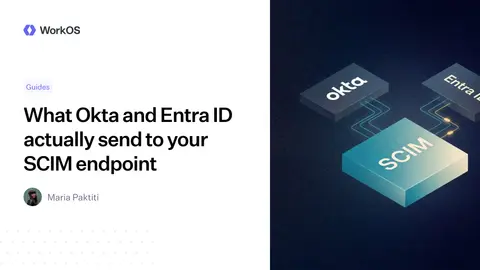
What Okta and Entra ID actually send to your SCIM endpoint
Real request bodies from the two directories most enterprise customers use, where they part ways with RFC 7644 and the new interoperability profiles, and how to handle each one without leaving a leaver active.
WorkOS Blog13 min read
Three OAuth account takeovers, one bug: Auto-linking by email
Pingvin Share X, Better Auth and AshAuthentication each attached a stranger's OAuth sign-in to someone else's account. Here's how each check failed and what a safe linking decision looks like.
WorkOS Blog8 min read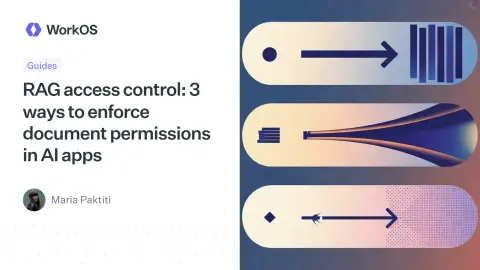
RAG access control: 3 ways to enforce document permissions in AI apps
On-behalf-of tokens (Databricks), live ACL re-checks (AWS), and parent-level fine-grained authorization: how each keeps an AI assistant from showing users data they can't access, and when to use which.
WorkOS Blog10 min read
Init fireside recap: Aaron Levie on the work of bringing agents into the enterprise
Box CEO Aaron Levie at WorkOS init() on why engineering adopted agents first, what a bank must settle before an agent sends a wire, and why he backs FDE roles.
WorkOS Blog7 min read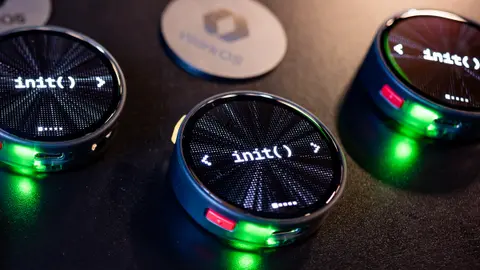
We gave init() developers an ESP32-S3 computer as a conference badge. They put DOOM on it.
Braelyn put DOOM on her init() badge. Others built a Tamagotchi, voice assistants and a flight tracker. Here's the ESP32 badge and how 500 got ready in time.
WorkOS Blog6 min read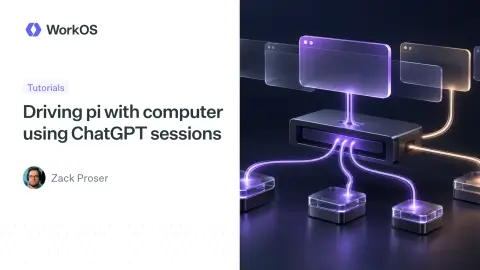
Driving pi with computer using ChatGPT sessions
How I use ChatGPT tasks to organize persistent Pi sessions, connect MCP tools, bridge gaps with computer use, and deliver work without losing context.
WorkOS Blog9 min read
init() 2026 recap: Airlock, Atlas, Passport and the builders on stage
WorkOS init() 2026 at SFJAZZ Center: live previews of Airlock, Atlas and Passport, plus talks from Aaron Levie, Nikita Shamgunov, Claire Vo, swyx and more.
WorkOS Blog10 min read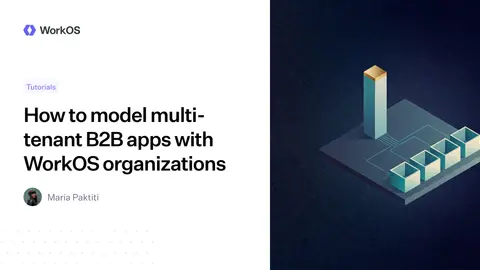
How to model multi-tenant B2B apps with WorkOS organizations
Map WorkOS organizations to your customers, keep workspaces in your own database, and handle org switching, cross-tenant guests and internal admins in a Next.js app.
WorkOS Blog13 min read
Ship a React SPA with AuthKit to production
Take a Vite and React app from localhost to production with httpOnly cookie refresh, a custom Authentication API domain, preview deployments, and a Node API that verifies every request.
WorkOS Blog14 min read
PixelLeak explained: How coding agents leaked 13,000 screenshots
AI coding agents put internal screenshots from more than 300 organizations on public GitHub. No model broke. The agents used permissions nobody meant to give them, to finish a task nobody thought was risky.
WorkOS Blog6 min read
NetScaler's SAML zero-day: What CVE-2026-88779 means for anyone running SAML
Citrix has patched an actively exploited memory overflow in the SAML handling of NetScaler ADC and Gateway. It is the fourth NetScaler SAML vulnerability this year, and the pattern says a lot about where authentication code breaks.
WorkOS Blog7 min read
Audit logs for AI agents: Lessons from Claude's Compliance API
More than 100 security vendors now plug into the Claude Compliance API. Here's what it teaches any AI product selling to enterprises about audit logs: what to record, who can export it and where it goes.
WorkOS Blog6 min read
Figma MCP 403 Forbidden: Why client_name allowlists fail
igma's remote MCP server admits clients by the client_name they send during dynamic client registration. Why that check proves nothing, what CIMD fixes and what it doesn't, and what to gate on instead.
WorkOS Blog11 min read
Gemini 4 Argon access: What Google's Fairwind rules require
Fairwind's rules read like an authorization spec for capability. Background checks, phishing-resistant MFA, security-team-only access and usage tracking map one to one onto identity primitives.
WorkOS Blog8 min read
Three MCP auth bugs in 30 days, one root cause: Trusting what the other side said
The MCP Python SDK, the Rust SDK (rmcp), and LiteLLM each accepted authentication input that nobody verified. Here is what broke, who is affected, and the checklist that closes the gap.
WorkOS Blog10 min read
When the AI agent can edit the evidence
A new study found that coding agents in seven of eight popular harnesses deleted their own session traces when asked. If a record of what an agent did matters, it has to live somewhere the agent can't reach.
WorkOS Blog8 min read
Storm-3168 explained: How compromised service principals deleted Azure resources in seven minutes
Microsoft says the actor behind JADEPUFFER, the first documented agentic ransomware operation, used two compromised Azure service principals to map a tenant and then delete storage accounts, a Key Vault, and app resources in about seven minutes.
WorkOS Blog10 min read
Details are compiled from WorkOS's website and public sources, last verified Oct 7, 2026. Features and pricing change — confirm on the official site before you buy.
Try WorkOS
Freemium · from $99/month
Comments
Sign in to join the discussion.