
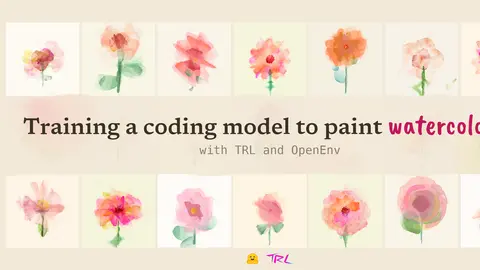
Training a coding model to paint watercolours with TRL and OpenEnv
We’re on a journey to advance and democratize artificial intelligence through open source and open science.
Hugging Face Blog20 min read
55 stories
We’re on a journey to advance and democratize artificial intelligence through open source and open science.

We’re on a journey to advance and democratize artificial intelligence through open source and open science.
We’re on a journey to advance and democratize artificial intelligence through open source and open science.
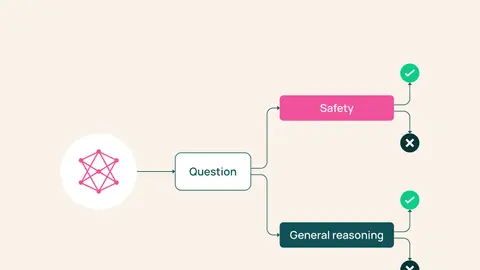
📄 Tech Report: http://allenai.org/papers/benchmirt | 📊 Data: https://huggingface.co/collections/allenai/benchmirt | 💻 Code: https://github.com/allenai/BenchMIRT
We’re on a journey to advance and democratize artificial intelligence through open source and open science.
We’re on a journey to advance and democratize artificial intelligence through open source and open science.
We’re on a journey to advance and democratize artificial intelligence through open source and open science.

TL;DR: Granite 4.2 is our first family of dense, decoder-only reasoning LLMs, released in three sizes: 3B, 8B, and 30B. These models are post-trained from Granite-4.1 base models.
Our latest paper, Quantization-Aware Healing: A Practical Recipe for Recovering Compressed, 4-Bit LLMs, asks a question that the field has mostly left open: once a model has already been through structural compression, not just quantization, how well does that recovery step actually work, and what…
We’re on a journey to advance and democratize artificial intelligence through open source and open science.
We’re on a journey to advance and democratize artificial intelligence through open source and open science.
We’re on a journey to advance and democratize artificial intelligence through open source and open science.
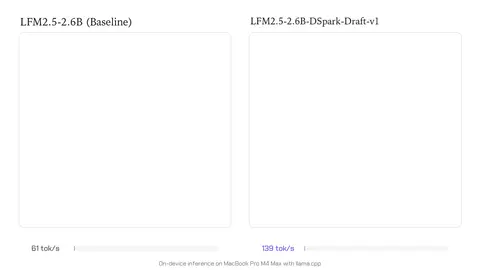
Today, we release DSpark draft model checkpoints for three models from our LFM2.5 family: LFM2.5-1.2B-Instruct, LFM2.5-2.6B, and LFM2.5-8B-A1B. These add a speculative decoding path that trades a minimal memory increase for a large decoding speedup without changing output quality:
Equipping an agent with agentic memory sounds simple: distill lessons from its past work, put them back in context, and more experience should mean better performance. It doesn't always work that way.

We’re on a journey to advance and democratize artificial intelligence through open source and open science.
The previous post argued that utilization, not intelligence, is where the next real constraint in enterprise AI is forming, and it closed by noting that no playbook has emerged yet for what a mature GPU Management practice looks like. This is ours.

We’re on a journey to advance and democratize artificial intelligence through open source and open science.
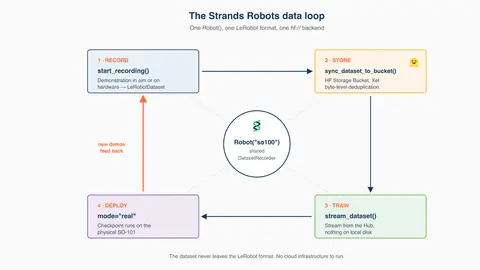
You have an agent that can already record a demonstration and push it to the Hugging Face Hub. Now you want to run that loop continuously: collect episodes through the day, train a policy on the growing dataset, deploy it, and pull the next batch back to improve it.
Showing 54 of 55 stories
Load more storiesGet the top AI news and tools straight to your inbox every week.
Weekly · AI news
Join 15,000+ AI enthusiasts