Know a great AI tool or AI news source? Submit it to AiByts

scikit-learn

32 stories

Stories

← Back to the latest stories
  • Many SWE-bench-Passing PRs Would Not Be Merged into Main

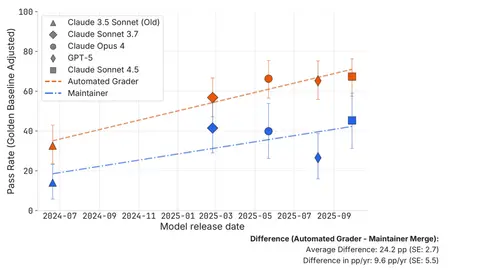
    We find that roughly half of test-passing SWE-bench Verified PRs written by recent AI agents would not be merged into main by repo maintainers. A naive interpretation of benchmark scores may lead one to overestimate how useful agents are without more elicitation or human feedback.

    METR14 min read
  • v0.13.1

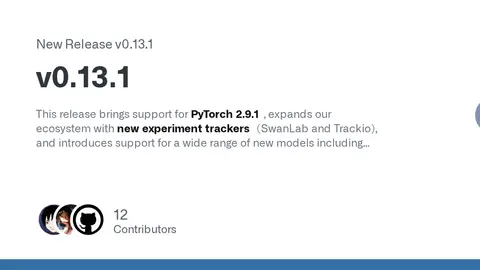
    Go ahead and axolotl questions. Contribute to axolotl-ai-cloud/axolotl development by creating an account on GitHub.

    Axolotl4 min read
  • Enhancing user experience through interactive inspection

    User experience (UX) has always been an important focus for scikit-learn. As we know, UX encompasses many aspects, but here we will focus specifically on how easy it is for the user to understand scikit-learn models during development, especially while using tools like jupyter notebooks.

    Scikit-Learn Documentation Blog2 min read
  • Interview with Virgil Chan, scikit-learn Team Member

    BIO: Virgil Chan is currently a Forward Deployed Engineer - Pre-Sales at Union.ai. Before that, he worked as a consultant in the San Francisco Bay Area, specialising in predictive data analytics and machine learning. Earlier, he studied mathematics before moving into data science.

    Scikit-Learn Documentation Blog5 min read
  • DESeq2 in Python: Step-by-Step PyDESeq2 Tutorial

    Run DESeq2 differential expression analysis entirely in Python with PyDESeq2. Covers count matrices, normalization, statistical testing, LFC shrinkage, and visualization.

    Runcell Blog10 min read
  • scikit-learn Completes the GitHub Secure Open Source Training

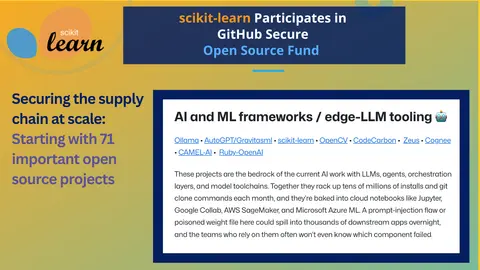
    scikit-learn was honored to be selected to participate in Cohort 2 of the GitHub Secure Open Source Fund (OSF) Training Program. Cohort 1 took place earlier in 2025 with 19 projects, and Cohort 2 took place with 52 projects during June 2025.

    Scikit-Learn Documentation Blog3 min read
  • Changes and development of scikit-learn’s developer API

    Historically, scikit-learn’s API has been divided into public and private. Public API is intended to be used by users, and private API is used internally in scikit-learn to develop new features and estimators.

    Scikit-Learn Documentation Blog4 min read
  • Announcing the launch of the scikit-learn user survey

    We are excited to announce the launch of the scikit-learn user survey! Scikit-learn continues to evolve thanks to contributions from its diverse user community. As we plan for future releases, we want to ensure we are focusing on what matters most to you — our users.

    Scikit-Learn Documentation Blog2 min read
  • Exploring Line Lengths in Python Packages

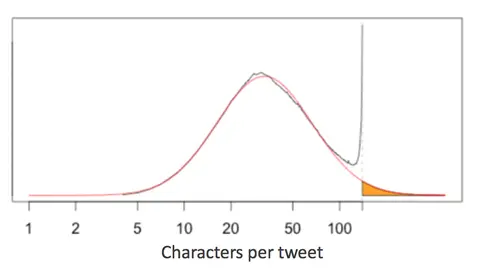
    This week, Twitter upped their single-tweet character limit from 140 to 280, purportedly based on this interesting analysis of tweet lengths published on Twitter's engineering blog.

    Python Data Science Handbook by Jake VanderPlas Blog11 min read
  • Reproducible Data Analysis in Jupyter

    Jupyter notebooks provide a useful environment for interactive exploration of data. A common question I get, though, is how you can progress from this nonlinear, interactive, trial-and-error style of exploration to a more linear and reproducible analysis based on organized, packaged, and tested…

    Python Data Science Handbook by Jake VanderPlas Blog3 min read
  • Learning Seattle's Work Habits from Bicycle Counts

    Last year I wrote a blog post examining trends in Seattle bicycling and how they relate to weather, daylight, day of the week, and other factors. Here I want to revisit the same data from a different perspective: rather than making assumptions in order to build models that might describe the data,…

    Python Data Science Handbook by Jake VanderPlas Blog13 min read

Showing 32 of 32 stories

You're all caught up.

AiByts Weekly Brief

Get the top AI news and tools straight to your inbox every week.

Weekly · AI news

Join 15,000+ AI enthusiasts