

Bifrost
Accelerates robotics research with GPU-parallel policy evaluation and failure analysis.
What is Bifrost?
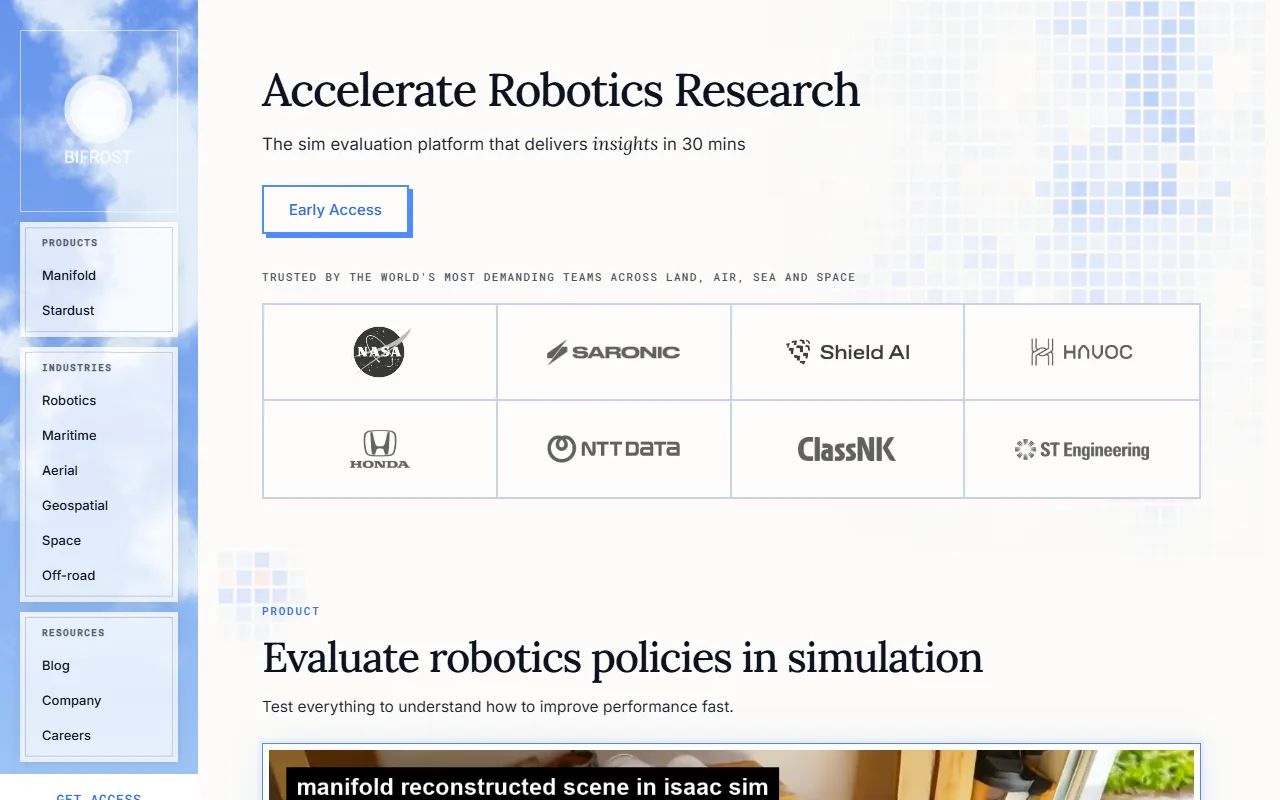
Bifrost is a Robot Simulation tool that accelerates robotics research with GPU-parallel policy evaluation and failure analysis. It is available on Linux. It is aimed at robotics researchers, ai researchers and robotics engineers.
Bifrost Manifold accelerates robotics research by enabling thousands of GPU-parallel robot policy evaluations with custom rubrics and agentic failure analysis. It provides insights in 30 minutes instead of days, helping researchers discover breakthroughs faster.
Built for robotics researchers, ai researchers and robotics engineers.
Key capabilities
Features
Policy Evaluation
Evaluates robotics policies in simulation.
Custom Rubrics
Allows creation of custom rubrics for policy evaluation.
Massively Parallelized GPU Evaluation
Agentic Failure Analysis
Benchmarks & Environments
Early Access
Offers early access to Manifold for users.
Use cases
- Evaluate robotics policies in simulation
- Discover breakthroughs earlier through policy evaluation
- Analyze failures in agent pipelines with agentic failure analysis
- Access benchmarks and environments for testing
- Get data insights in minutes instead of months
- Accelerate research loops using GPU-parallel evaluations
Who it's for
- Robotics Researchers
- AI Researchers
- Robotics Engineers
Pros & cons
Pros
- Public API available
- Supports Linux platform
Cons
No documented limitations yet.
Developer & API
Public SDK API available
FAQ
What is Bifrost?
Bifrost is a Robot Simulation tool that accelerates robotics research with GPU-parallel policy evaluation and failure analysis. Bifrost Manifold accelerates robotics research by enabling thousands of GPU-parallel robot policy evaluations with custom rubrics and agentic failure analysis. It provides insights in 30 minutes instead of days, helping researchers discover breakthroughs faster.
Does Bifrost have an API?
Yes, Bifrost offers a public SDK API for building custom integrations.
What platforms does Bifrost support?
Bifrost is available on Linux.
Who should use Bifrost?
Bifrost is built for robotics researchers, ai researchers and robotics engineers. Common uses: evaluate robotics policies in simulation, discover breakthroughs earlier through policy evaluation, analyze failures in agent pipelines with agentic failure analysis and access benchmarks and environments for testing.
What are the best alternatives to Bifrost?
Similar tools on AiByts include Atlas, H1, Figure 03, Apollo and NEO.
Bifrost news & updates
Synthetic Data For Defense ISR: EO/IR Training Data For Perception Teams
Synthetic data gives ISR perception teams labeled EO/IR and SAR imagery of rare targets they cannot collect or share. Train on it with some real data, then test on real.
Bifrost Blog13 min readWhy VLA Policies Fail: Common Failure Modes In Simulation
VLA policies fail by grabbing the wrong object, missing grasps, closing on air, stalling and not recovering, and they get worse when cameras, layouts or wording change.
Bifrost Blog12 min readSynthetic Data For USV Collision Avoidance And Maritime Lookout
Synthetic data gives USV lookout models the rare, dangerous cases real footage lacks, like swimmers, debris, night and rough seas. Train on it, validate on real video.
Bifrost Blog13 min readRobot Policy Evaluation Platforms Compared (2026)
Isaac Lab-Arena, RoboLab, LeRobot and SimplerEnv evaluate robot policies in simulation, RoboArena and AutoEval on real robots. The right one depends on your benchmark.
Bifrost Blog11 min readpi0.5 LIBERO Results, Reproduced On Manifold
We ran the public pi0.5 LIBERO checkpoint for 1,999 episodes across all four suites and averaged 96.7%, against 96.85% reported by openpi. Per-suite results and rerun spread.
Bifrost Blog6 min readHow Many Trials Do You Need To Evaluate A Robot Policy?
About 100 trials gives a 95% interval of roughly ±8 to ±10 points on one success rate. Telling two policies 10 points apart takes 199 to 388 trials each.
Bifrost Blog12 min readSynthetic Data Platforms For Computer Vision, Compared (2026)
The best synthetic data platform depends on your domain and sensors. We compare NVIDIA, Duality, Parallel Domain, Rendered.ai, Anyverse and others as of October 2026.
Bifrost Blog10 min readHow To Run LIBERO Evaluation And Reproduce Published Results
Run each LIBERO suite from its 50 fixed initial states, 50 episodes per task, with step limits of 220 to 520, then match the training image rotation and action chunking.
Bifrost Blog12 min readCan You Trust Simulated Robot Policy Evaluation?
For ranking policies, often yes. SIMPLER reports a 0.924 Pearson correlation with real results and PolaRiS 0.90, but sim success rates rarely match real ones.
Bifrost Blog12 min readIs LIBERO Saturated? What Top Scores Hide And What To Report
Largely, yes. Top VLAs report 96 to 98% averages, but LIBERO-PRO and LIBERO-Plus perturbations drop several to near 0% when objects move, tasks change or cameras shift.
Bifrost Blog10 min readBest Simulation Benchmarks For VLA Models In 2026
The best VLA simulation benchmarks in 2026 are LIBERO-Plus or LIBERO-PRO, RoboCasa365, RoboTwin 2.0, RoboLab and SimplerEnv. Plain LIBERO is saturated at 97.1%.
Bifrost Blog12 min readSynthetic Thermal Infrared Training Data: How To Get Labeled IR Imagery
Labeled thermal IR training data comes from three routes: hand-labeling real frames, translating RGB images to thermal, or rendering scenes with physics-based simulation.
Bifrost Blog12 min readHow To Close The Sim-To-Real Gap For Perception Models
Measure the gap on held-out real data, model your sensor, randomize appearance, match the real content distribution, then fine-tune on a small real set.
Bifrost Blog11 min readDoes Synthetic Data Work For Object Detection? What The Evidence Says
Yes, mostly as a complement. Pretraining on synthetic images and fine-tuning on a small real set beats real-only training in most published results.
Bifrost Blog10 min readSimplerEnv Alternatives For Real-To-Sim Policy Evaluation
The main SimplerEnv alternatives are PolaRiS for DROID policies, RoboLab in Isaac Lab-Arena, Gaussian-splat soft-body twins, RobotArena ∞, and real-world RoboArena.
Bifrost Blog11 min readSynthetic Data For Drone Detection: What The Research Shows
Synthetic data improves drone detectors most when mixed with real images. Published hybrids beat real-only training, while synthetic-only models trail on hard test sets.
Bifrost Blog12 min readIsaac Lab vs MuJoCo vs ManiSkill vs Genesis For Policy Evaluation
For policy evaluation, the benchmark usually picks the simulator. LIBERO and RoboCasa run on MuJoCo, SimplerEnv on ManiSkill, Isaac Lab-Arena tasks on Isaac Lab.
Bifrost Blog11 min readHow To Evaluate Robot Policies In Simulation At Scale
Eval time goes to policy inference, sim stepping, rendering and resets. Vectorize environments, shard across GPUs, batch inference and serve the policy separately.
Bifrost Blog12 min read
Details are compiled from Bifrost's website and public sources, last verified Oct 3, 2026. Features and pricing change — confirm on the official site before you buy.
Try Bifrost
Visit the official website
Tags
- Robotics Research
- Policy Evaluation
- GPU Acceleration
- Agent Safety
- AI Governance
Comments
Sign in to join the discussion.